Sunday, March 28, 2010

Bingeing on Bava


I've been bingeing on Mario Bava films lately, possibly spurred on by my rediscovery of "Twitch of the Death Nerve". I've always loved Bava's films and his camerawork, but I've never watched so many of them close together. I'm already familiar with Bava's "Lisa and the Devil", "Blood and Black Lace", and "Kill Baby Kill". I'd seen "Death Nerve" (under the title "Bay of Blood") once before, but I recently dug it out of my old VHS collection and gave it a rewatch, and this time I was really taken by it.

"Twitch of the Death Nerve" is a brilliant forerunner to the mad slasher "body count" movies. While Bava was clearly riffing on the Giallo style that was so popular at the time, what he was actually doing in "Twitch of the Death Nerve" was closer to what developed in 80s films, starting with "Friday the 13th", which was heavily influenced by it. Even more so the sequel, "Friday the 13th Part 2", which took several murder sequences directly from "Death Nerve". But in Bava's film, the bizarre murders are simply part of the morbid fabric of his atmosphere, which was lush with color, texture, and retro chic. The setting of a wooded bay appears green and almost tropical through Bava's lens, even though in reality it was filmed in an area with very few trees. The film contains more unsettling images within its reels than most: a man gets his face bisected by a machete. The bloated face of a corpse is lovingly caressed by the arms of an octopus that seems to be feeding on it. A writhing beetle is shown impaled alive on a pin. Bava also avoids the typical mad slasher format by filling his flick with multiple killers, all motivated by the potential to acquire a large inheritance.


"Schock", aka "Beyond the Door Part II", is Bava's final film, and is a mixed bag. Although it contains enough of Bava's touch to be interesting, it ultimately fails as a film due to a number of wandering passages and a lack of suspense. Daria Nicolodi plays a woman terrorized by the ghost of her dead husband, which possesses their seven year old son. Bava had riffed on "The Exorcist" before, with the dreadful but amusing possession scenes he filmed with Elke Sommer to create "The House of Exorcism" (itself a re-edited version of an older, eons-better film "Lisa and the Devil"). But in "Schock", the possession element takes a back seat to the film's true haunted house soul. There are a few startling, mind-bending shots in the film, such as when the little boy reaches out to caress his sleeping mother's throat in an erotic manner, his hand appearing as the hand of a corpse. Another brilliantly imaginative scene follows the progress of a ghostly image that prowls the walls of the house's basement, circling the perimeter. It is very clearly a cutout image and at first we think the director intends for us to believe it is a ghost, but then the camera pans back to reveal the little boy, holding a family photograph with his new father cut out of it; the prowling "ghost" is the light of a bare bulb shining through the cut out photograph. The most terrifying image in "Schock" is one that was unforgivably revealed in the film's trailer, a breathtaking gut punch as the little boy rushes toward his mother from the other end of a hallway, morphing into the adult-size corpse of his father just as he reaches her.

An older film of Bava's, "Hatchet for the Honeymoon", made the rounds on late-night television with "Lisa and the Devil". I saw it as a kid and was totally uninvolved with it, although it plays much better now that I can appreciate Bava's art. You don't usually watch them for the literal stories, it's all about the visual narrative. "Hatchet" reminds me of staying up too late to watch movies on our local affiliate; it was a difficult movie to stay awake through back then. The very bizarre plot inverts the typical giallo structure by revealing the serial killer as the film's protagonist right away, a disturbed Bates Motel type who harbors mother issues and works them out by murdering brides with a meat cleaver. Although the setup is unremarkable, Bava fills in the blank spots by setting the story in a classically gothic environment; his killer inhabits an old-money style mansion with miles of intricate woodwork and ornate protrusions. The murders are disappointingly bloodless, somewhat confusingly so since they're carried out with a meat cleaver. But just try not to be impressed when Bava's villain/hero tries to throw off the cops by explaining that the screaming they heard coming from his house was actually coming from his TV set, which happens to be playing a clip from Bava's own "Black Sabbath".

Props have got to be given for the music Bava includes in these films, too. "Death Nerve" features a score by Stelvio Cipriani that mimics the exotica style of Les Baxter and Martin Denny. "Schock" is scored by Goblin, working under the name Libra, and although they seem to have saved their best stuff for Argento, they reveal some of the same magic. "Hatchet" doesn't have such a memorable score, although it's punctuated by eerie touches like a music box theme that plays during a crucial death sequence.

Wednesday, December 2, 2009

Farewell, Paul


Jacinto Molina, aka Paul Naschy, 1934-2009.

Wednesday, November 4, 2009

Look What's Happened to Rosemary's Baby: 70s Doom, made for TV style!

First off, raise your hand if it's a surprise to you that there's actually a sequel to "Rosemary's Baby". Yeah, that's what I thought. "Look What's Happened to Rosemary's Baby" is a made-for-TV movie. That's the first of several bitter pills that must be swallowed during the course of this film. Not to mention that swallowing some BEFORE the film begins will undoubtedly make your viewing experience more pleasurable. Suffering from such maladies as a psychotic script, some stilted acting, and sub-par special effects (whenever such things are attempted) you may correctly assume that this sequel to Roman Polanski's 1968 suspense film does not live up to its heritage. What a pleasant surprise, then, to find that this ultra-obscure sequel to a horror classic is a wacky 70s Doom film full of hallucinogenic images and a constantly downbeat tone.


The many faces of Andrew/Adrian
We're introduced right away to none other than Patty Duke standing in for Mia Farrow. A series of voiceovers, yet another 70s Doom hallmark, removes the need for an actual coherent narrative, and we hear the dialogue from the end of the first film. Then we finally arrive in the present, with Andrew/Adrian (even Rosemary herself can't seem to get it straight) now aged 8 and doing his best to look like an escapee from Village of the Damned. Patty Duke isn't going to make you forget Mia Farrow anytime soon, although her performance is only the first in a parade of bad ones contained in these cursed reels. Ruth Gordon returns as everyone's favorite Satanic smoothie maker, Minnie Castavet, and the best we can say about her is yeah, she's the same actress from the original. No matter, she can't pretend that she's happy about being in "Look What's Happened to Rosemary's Baby", and she looks embarassed. Ditto for Ray Milland as Roman Castavet, who has the unfortunate task of reciting the movie's exposition in a series of voiceovers that move the plot along like a tow truck moving a totalled Pinto.

Marjean says, Have you seen my wig around? I feel naked without it.

Guy Woodhouse is now played by George Maharis in a particularly hideous 70s makeover. The coven is intent on making Adrian live up to his destiny as the son of Satan, but Rosemary sneaks Adrian away from them and takes him on the run. They use their ESP radar powers to spy on Rosemary, but she takes refuge in a synagogue and they can't "see" her in there. She throws them off her trail and takes a Greyhound bus into the desert, where Adrian uses his glowing red eyes to rough up some bullying kids who try to steal Adrian's toy car. The fracas flushes none other than Tina Louise out of her trailer, and she ushers Rosemary and Adrian into her little abode to take cover. Tina Louise's character is Marjean, a low-rent hooker who picks up a phone call from the Coven and apparently winds up hypnotized for the rest of her life, forced to care for Adrian while tricking Rosemary into boarding a Satanic driverless bus bound for some presumably awful place. The last we see of poor Rosemary, she's pounding her fists against the back windows of the bus as poor Adrian looks on. If this scene did not traumatize you as a child in the 70s, you were probably already torturing small animals.

From there, we jump forward many years. Marjean's hair is now in a hooker bun, so we know time must have passed because only older women wear their hair like this, right? She now runs a casino, which also happens to feature a groovy house band. Adrian is a far out 70s young miscreant who likes driving cars real fast, playing guitar, and drinking. So far, so good. But wait a minute...if Adrian was born in 1966, and he's in his early 20s now, this would mean it was the late 80s. Apparently in 1976, filmmakers thought the 70s would never end, that somehow we had arrived at the only possible conclusions in terms of fashion, music, and overall grooviness. But, whatever.

Adrian is supposed to be a rock musician, and he has a creepy Jim Morrison vibe going on for sure, but unfortunately we never get to see him perform, which is one of the movie's biggest missteps. Adrian has a best friend who helpfully dresses in white all the time so we'll know he's a force of good. If that isn't enough to penetrate your skull, the screenwriter helpfully named him Peter Simon, and I'm sure he's got a few other middle names in there like Mark and Matthew. Peter tries to convince Adrian to "split" with him for San Francisco, and encourages him to get in touch with his mysterious, dimly-remembered past. Minnie and Roman, who don't look a day older than they did during the opening sequence, arrive on Adrian's birthday to give Adrian one of Minnie's famous mind-altering milkshakes, which causes him to go into a trance. It seems the coven has decided it's time for Adrian to get the business of Antichristing underway, whatever the hell he's supposed to be doing. Roman helpfully explains that it's possible Adrian will flake out on them, in which case they'll simply kill him. Gee, after all that? In what could possibly be the movie's best/worst scene, they paint his face like a mime and perform a brief TV-movie ritual, which ends with Adrian shambling up onstage at a concert and boogeying around with a weird mask on. Yes, it's the evil power of...funk music. Then Peter Simon gets electrocuted when Guy Woodhouse gets tired of him and picks up a downed power line and touches him with it. How, you ask, could Guy pick up a downed power line and kill somebody with it without being electrocuted himself? I guess we're supposed to believe in the devil, after all.


Adrian invents shock rock before our very eyes

The film's final third really sends it into the 70s Doom stratosphere: a mental institution, complete with shock therapy scenes and machines that attach to people via wires. It seems that Adrian's birthday party took a turn for the worst. Not only was Peter Simon fried with a live wire, but the entire place burned down and Marjean was killed, too. Poor Tina Louise, even her death occurs offscreen. In a moment of forced plot exposition emotional drama, a helpful nurse named Ellen tells Adrian while he's writhing on a gurney "Adrian, you're all alone now. Your aunt died, your friend died too!" Adrian has some kind of selective amnesia, but the police think he's the one who killed Peter Simon, since Adrian's fingerprints were on the downed power line. You'd think the police would question how ANY living person's fingerprints could be on a live power line, but never mind. The helpful nurse Ellen, played by none other than Donna Mills, helps Adrian escape the institution. When Guy gets wind of the fact that Adrian is out, he gets super paranoid and is convinced Adrian will try and kill him. Ellen, on the other hand, takes Adrian to a hotel and gives him some drugged wine. Uh oh. After putting on a sexy red nightie, she reveals that she is somehow one of the cult, too, and she has sex with the zonked-out-of-his-gourd Adrian. In a TV-movie kind of way, anyhow. Afterwards, Adrian wanders outside into the parking lot of the hotel and is nearly run down by a mysterious black car, which ends up hitting Ellen instead. Adrian tells the police not to bother checking inside the car because nobody would be driving it -- wait a minute, were the makers of 'The Car' watching this movie?? -- but when the police open the driver's side door, inside is GUY WOODHOUSE. Can you believe this Guy? First he sells out his wife to a Satanic cult, allows her to be raped by the devil, sends a rival actor blind, then he thinks he can just run over Rosemary's baby with a car? Good thing the crash kills the pompous ass. Adrian is so freaked out that he uses his supernatural red-eye power to shake off the police and run away.

All that's left is for the big reveal: in a doctor's office, Minnie and Roman talk to each other and bemoan the loss of their ability to control the devil child Adrian, but they are oh so happy when the doctor tells them their "granddaughter" has fully recovered from her injuries and will have a normal pregnancy. YES...it's Ellen! Pregnant with the grandchild of Satan! Finally it all makes sense...Roman planned the whole thing and sent Ellen to get knocked up by Adrian. Once the deed was in progress, he tapped Guy and told him to murder Adrian, but he hit Ellen instead. Fortunately he didn't kill her. The TV-movie end credits show her giving birth to another spooky baby to carry on the saga of doom.

Well, if anybody asks you what happened to Rosemary's baby, you just tell them this: His mother got carried off by a phantom bus, he had a hooker for an adoptive parent, and eventually he got date-raped by Donna Mills. None of this is particularly terrifying, not even the electrocution of a major character, because after it happens you're left thinking "WTF just happened??" But I actually LIKED "Whatever Happened to Rosemary's Baby", because even though it's got problems, it's extremely unique, at the very least. It's less a horror movie than a film about what personal crisis might result from being the offspring of Lucifer. It also doesn't go for the obvious; it would have been easy to make a movie where Adrian went around killing off people by pushing them off balconies and cutting their heads off with plate glass. Instead, it turns into a doomy 70s TV-movie with trippy photography (lost due to the fuzziness of the bootleg prints circulating), bizarre characters, and strange dialogue. It's a little rough around the edges, and for a movie about the Devil it asks for a lot of forgiveness. But Adrian makes a compelling hero if you squint real hard, and these kind of "finding yourself" movies were very common in the 70s. The kooky scenes with the Castavets are fun, like where Roman gives Adrian a joint at his birthday party and admits that Minnie and himself have "tried it". Watch it and be transported back to a time when something could still be called 'Movie of the Week'.

Never mind the baby, look what happened to poor Rosemary!

Thursday, October 8, 2009

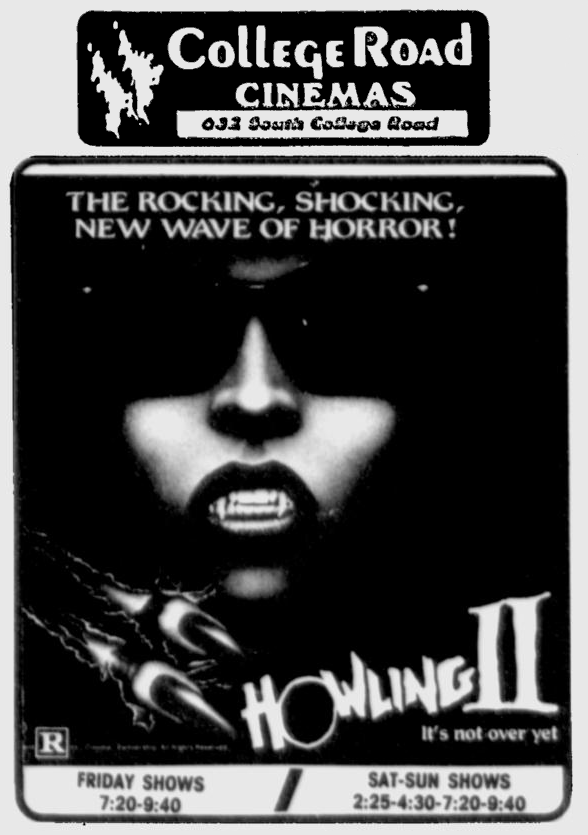
Howling II: Werewolf Bitch, Please.

There have been some pretty crappy "Part 2" movies in the history of sequeldom. "Exorcist II - The Heretic". "Poltergeist II". "Jaws 2". "Piranha 2: The Spawning". "Troll 2"...well OK, was "Troll" really all that great? My own personal favorite Terrible 2 is "Howling II". The appropriate subtitle of the movie depends on where you lived when the movie was released. It was known in various places as "Howling II: Your Sister Is A Werewolf", "Howling II: Stirba, Werewolf Bitch", and "Howling II: It's Not Over Yet". No matter where you lived, however, "Howling II" was definitely known as a rotten, stinking crapfest of a movie.
Tell me the truth...do these glasses make me look conspicuous?
The first time I saw it was when I rented the big clunky VHS from our local mom & pop video rental store (except I think it was actually a mom & mom outfit). I took it home, watched it, and couldn't f'ing believe that this...this...thing...was the sequel to "The Howling". I mean, the original was one of the most totally awesome werewolf movies in the history of anything, and it was always my opinion that it was a thousand times better than "An American Werewolf In London". So why was the sequel like some sadistic movie producer's revenge on an unsuspecting moviegoing public? I do my best to love bad movies, though, so I ordered me up some "Howling II" on DVD via Netfux. Well ya know what? It's still a bad movie. But now that I am a few decades past my initial disappointment, it's a bad movie that I can really dig.
It's always about the hand with her.

Serious props must be given to those without whom this movie would not be digable at all. I'm talking, of course, about Christopher Lee, Sybil Danning, and Sybil Danning's boobs. If I had been into chicks, I would have never cared that "Howling II" sucked, because it has Sybil Danning in it and she wears a rip-away bra in the movie. She also has some of the most outrageous costumes this side of She-Ra. And even though I'm not into boobs, I am not blind, and I know when a woman has nice boobs, and Sybil Danning's got em. At least, she did when this movie was made. The producers of the movie knew it, too, because they take a scene where she rips off her bra and they repeat it about 25 times over the end credits. No, really. They do.
Why don't I get a decent transformation like Picardo did in the first one?
The genius producers of the film also knew not everyone is into boobs, so they got Christopher Lee to be in their stupid movie. It's amazing that he agreed to do this, but there he is. As a reward, the director lets Chris wear a far out pair of wraparound sunglasses while spying on a group of werewolves in a "punk" club. You'd think Christopher Lee would stand out, seeing as he's a 60-something gray haired man in a middle of a club where the average age is 25 and everyone has hair that looks like it was run over by a lawnmower, but the shades really lend an element of disguise to his getup.

The film's story involves the brother of Karen White, Dee Wallace's character from the original movie. At Karen's funeral, Christopher Lee shows up and tells brother Ben that his sister is a werewolf. After much protest, Ben realizes that Chris is 200% correct, and with his TV-news reporter girlfriend in tow, he joins Chris on a trip to Transylvania to do battle with Stirba, queen of the werewolves. Sybil Danning plays Stirba, who has got to have a damned good Transylvanian hairdresser tucked away in her castle somewhere. Early on in the film, she has a menage-a-trois with two other werewolves, and here is where we first discover the movie's biggest problem: it doesn't know what a werewolf is. "Howling II" believes that if you sprout hair all over your body and put on a Planet of the Apes mask, then you're a werewolf, and it proceeds full speed ahead with this concept. Of course "The Howling" had KICK ASS werewolves, so right away we see a big problem with this sequel. Obviously the filmmakers knew this, because they have their werewolves do things like roll around in bed snapping at each other and clawing one another.

Stirba demonstrates the internationally-recognized gang hand sign for werewolves

The 'good guys', with Chris Lee and the other two imbeciles on their side, gather in the village and then set out to raid Stirba's castle, while Stirba calls a meeting of werewolves. At first she indulges them in an orgy, then sends them off to do battle against Chris Lee and his four other warriors, who are armed with titanium bullets. You'd think that 30 werewolves wouldn't have any trouble taking out five human beings walking through a dark forest, but these damn wolves don't have all their dogs barking. They just lurk in the bushes a lot, then lunge at the people one at a time. With that kind of an army backing her up, Stirba might as well have walked down into town waving a white flag. But lo and behold, we find out that Stirba and Chris Lee's character are actually brother and sister, and Stirba wants him to become her lover. If she had succeeded in seducing her brother, she would have smashed the taboos of bestiality AND incest in one fell swoop, but instead she gets stabbed in the heart. All that, and all he had to do was walk up to her and stab her? We don't know how she ever got to be Queen of the Werewolves, unless she lucked into it when her predecessor died of heartworm.

"Howling II" is one of those bad movies you just kinda have to see to understand. I can't imagine anybody thinking it's a "good" movie, but I doubt you'll realize just how weird and strange things can get in a "part two" sequel before you see Sybil Danning rip her bra off nineteen times in a row.


Let's Scare Jessica To Death (1971)

There ain't a better example of prime 70s low budget horror than "Let's Scare Jessica To Death", the kind of movie that doesn't show you as much on screen as it does in your own head, making implications and suggestions while never really stating exactly what is happening. It's strange that the movie's title and ad campaign seemed to position it as an exploitation shocker. While it's definitely low budget, it doesn't have much in common with the grindhouse movies that it was undoubtedly paired with at the drive-in. On the surface it's a movie about a ghostly vampire who inhabits an island community, but at its heart is a story about a likable, fragile woman who knows she is losing her grip but can't do anything about it.

Happy Jessica / Losin' It Jessica

The film opens and already we're treated to a hallmark of the 70s Doom genre....the flashback moment! Here is Jessica, alone and despondent, sitting on a rowboat in the middle of a lake wearing nothing but her nightgown. How did she get there? Well, the helpful watery dissolve takes us back to the beginning, when we see Jessica, her husband Duncan, and their friend Woody traveling in a big black hearse. Woody is kind of a hippie, Duncan is a bald guy who looks pretty uptight for a professional musician--he's leaving behind a position with the New York Philharmonic in order to get Jessica away from the city. Jessica has just spent some time in a mental institution, and her doctor has finally released her. Duncan has taken his life savings and purchased a farmhouse on an island in Connecticut.

Jessica's fabulous nervous-breakdown pad.
Jessica's breakdown is not entirely behind her. She is haunted by voices in her head, and we hear them whispering to her even from the very beginning, when she is in a graveyard doing tombstone rubbings and sees a strange girl watching her. "Don't tell them, they won't believe you." Jessica doubts her own sanity after her breakdown, and she assumes that Duncan and Woody do, too. When they arrive at the farmhouse, Jessica sees another strange girl on the porch. The others see her too, and Jessica seems relieved. "I really did see something!" she smiles. It seems like all she needs is for someone to sneeze in the wrong direction and she'd go teetering over the edge again.


Hi I'm Abig-errr, Emily. Yes, Emily. My name's Emily.
They discover that the girl in the house is Emily, a young drifter who was squatting in the house because she thought it was abandoned. She gathers her things to clear out, but Jessica feels bad for her and asks her to stay the night. That evening consists of some dinner-eatin', guitar strummin', and spirit summonin'. Yes, Emily suggests that they hold a seance, never a good thing in a movie whose very title suggests that someone will be scared to death. Nothing happens during the seance, but it sure creeps Jessica out.

More things begin to happen to Jessica that make her question her sanity, but there really does seem to be something weird going on. An antiques dealer in town gives them the lowdown on their new home's bizarre history; he reveals that the three subjects in an antique photograph that Jessica finds in the attic are none other than the Bishop family, Abigail Bishop and her parents. Abigail drowned on her wedding day, and is rumored to roam the countryside as a vampire. Could this explain why Emily looks exactly like Abigail? Is this why the town seems to be populated entirely by old men with bandages on their bodies?
Boy, caring for this orchard is murder.
Of course it doesn't take much to figure out that not only is Jessica losing her mind, Emily is the long-dead Abigail, insinuating herself into their lives. However, it's Jessica's breakdown that really delivers the chills. Zohra Lampert is great as Jessica, who is likable and friendly, but slowly drawn back into whatever madness she was suffering from. It's no wonder, seeing as she's being attacked by vampires, but is it really happening to her? Or is she just imagining everything? Either explanation is just as bad.

I first saw "Let's Scare Jessica To Death" on TV as a kid. I think it was on the CBS Late Movie on Friday night, but I can't be entirely sure. I do remember the introduction for it, with the super-serious, deep voiced announcer saying the name of the movie like it was the most terrifying thing you'd ever see. Well I admit I was just a kid, but the movie still gets under my skin. It has a very heavy atmosphere, full of whispering voices on the soundtrack, bizarre old men, dead pet moles, and spooky houses. As a kid I had no concept of a mental breakdown, and the fact that Jessica is trying to turn her life around and recover makes it all the more compelling to see her losing her grip.  Zohra Lampert delivers a very physical performance, often based on simple facial expressions and subtle moments rather than the screaming and terror that other horror heroines are usually called on to project. She really gets us inside her character's head, aided by the film's bizarre audio mix that often loops her own inner thoughts over footage of her face reacting to the weirdness going on around her. Just as good is Mariclare Costello, who is very scary and sexy as Emily/Abigail, just like a good vampire should be. She gets her own whisper track, too, a menacing one.

A terrific and scary moment is when Lampert and Costello are sunning on a raft and suddenly Costello pushes Lampert in the lake and seems like she's trying to drown her, and Lampert feels powerless to try and stop her. The sequence is even more uncomfortable because Costello keeps touching Lampert intimately and trying to kiss her, combining the attempt on her life with sexual advances. The vampires in the film are not the kind that need to avoid sunlight, there's more of a similarity between them and the helpless disease victims that David Cronenberg created later in films like "They Came From Within" and "Rabid", or the living dead cannibals in "Messiah of Evil": ordinary-looking people who suddenly want to bite or scratch you so you'll be just like them. But by the time the movie comes full circle and we wind up with Jessica again, floating all alone on that rowboat in her nightgown, the fact that the movie was about vampires is somehow forgotten. Although there's nothing in it that'll scare you to death, this movie left me with an uneasy feeling that lasted a long time after the credits rolled.


Sunday, September 27, 2009

Pigs (1972)


When it comes to 70s drive-in movies, there's crazy, then there's pig crazy. In "Pigs", an absolute riot of blood, murder, incest, and 70s doom, the craziness is of the swine variety. Although I love it, I also feel bad for people who were lured into thinking it was about killer pigs. There are pigs in it, and they eat bodies, but that's kind of like someone getting ahold of "Silence of the Lambs" and retitling it "Cellar" and making it seem like it's about a killer basement.
Lynn practices her stab-aerobics routine.
Written and directed by the prolific character actor Marc Lawrence, who starred in several hundred movies and TV shows, this one seems to have been tailor made for his daughter, Toni Lawrence. 


Lynn discovers she does not have enough pocket change to pay the toll rates for "beyond the grave".

As the movie opens, we learn that getting a baby is kind of like going grocery shopping. A voiceover, presumably from a maternity nurse, states "Here's your baby daughter, Mr. Hart!" and we see a proud, happy papa leaving the hospital with an infant wrapped up in blankets. No actual mother is in sight. A flash-forward series of images explains that the baby grew into a young girl whom Daddy liked to feel up, that is until one night she murders him with a kitchen knife. Her name is Lynn, and she is seen talking to a psychiatrist, asking where her father is. Apparently she forgot about stabbing him to death. She insists to a doctor "It's a lie!", prompting the shrink to commit her -- this is done with a large rubber stamp that marks Lynn's file COMMITTED -- and sign her up for immediate shock treatment. Conveniently for Lynn, a slutty nurse seduces an old fart doctor right there on the ward, leaving her nurse's uniform behind alongside her car keys. Lynn steals the uniform and the keys, somehow instinctively knowing which car belongs to the poor nurse, and she's off and running. She is accompanied by her own 70s doom song that encourages her to keep on drivin', cause someone is waiting for her down the road to take her in.
"I told you someone was waiting down the road, dearie."
That someone is a scary-looking nutcase named Zambrini, who we meet just as he is feeding a freshly-exhumed corpse from the local cemetery to the pigs that he keeps penned up behind his house. In an important soliloquy and plot exposition, he explains to the corpse that the pigs once stumbled upon a drunk guy sleeping it off in a field and ate him. Of course the thing to do was to encourage their appetite for human flesh instead of just killing the damn pigs. Lynn shows up at Zambrini's "diner", which is really just a farmhouse set back in a field with a large front window. Somehow when characters step inside the door, it becomes a diner (movie magic at work!), and sooner than you can say "Alice Hyatt", Lynn is hired as a new waitress at the farmhouse diner.

Zambrini shows Lynn to her room without saying more than a few sentences to her, and in a moment of intense foreshadowing, Lynn opens up the bathroom medicine cabinet and finds....A STRAIT RAZOR! Pretty soon the locals come sniffin' around, and Lynn meets Sheriff Dan Cole, who tells her that not only is the registration expired on "her" car, it's a missing vehicle. For some reason, Dan does not seem to think this is unusual, and doesn't report it. A sleazy customer named Ben comes in and tells Lynn that Zambrini was a circus performer who fell off a high wire (or something) and was pronounced dead, only to reawaken at the morgue. How's THAT for a circus trick? Ben begs Lynn for a date, and when she finally gives in, he drives her into the middle of nowhere in his pickup truck and tries to rape her. Dan drives by in his squad car, immediately sensing that Ben is up to no good, but darn that laid-back sheriff, he just lets it slide and drives Lynn back home. Lynn pays Ben back by inviting him into her bedroom the next night, putting on a sexy strip show for him, then slashing him to death with Zambrini's razor. Zambrini walks in and comforts Lynn, then disposes of the body by feeding it to those handy pigs out back, you know, the ones that like to eat corpses? A beautiful friendship has begun.

"SHOULD I have kept on driving?"
Although the focus of the film is Lynn and her stabby ways, there is also an implied supernatural element. Zambrini's closest neighbors, two elderly spinsters (played by Catherine Ross and Iris Korn), seem to suspect what Zambrini is up to, and they believe that whenever Zambrini feeds a new corpse to the pigs, another pig appears in the pen, the reborn embodiment of the tormented soul that's been fed to the animals. They and Lynn also experience auditory hallucinations of pigs snuffling and squealing around their bedroom windows.

Don't look at me, I didn't know what that shit was he was feeding us.
For a cheap drive-in screamer, "Pigs" is ambitious in the way it attempts to develop Lynn as a character, and Toni Lawrence carries a few difficult scenes extremely well. Periodically throughout the film, she makes phone calls to some disconnected phone number and thinks she's talking to her father; Toni has this multilayered life that she's created for Lynn, where she sometimes appears normal on the surface, but she'll give this sneaky look before slipping off to the payphone to make one of her imaginary phone calls. She's got this secret life, and she's found a secret place to carry out these strange impulses. Another scene features her playing with her hair and staring off into space while Sheriff Dan questions her, and while he seems frustrated by the fact that she won't either look at him or answer his questions, this apparently isn't enough to set off enough warning bells in his thick head. He's a classic 70s tool who's too dumb to connect the dots, and ya gotta love that.


"Zambrini! Bring me the cleaver!"
Aside from the low budget, the worst thing "Pigs" has going for it is its very slow pacing. It takes a long time to get going, and really it never takes off running. It just smolders in its own doomy atmosphere, until an admittedly gory finale where a body is dismembered and fed to the pigs on camera in a series of rapid-fire cuts. In terms of low budget cinema, it's not as technically proficient as the films of S.F. Brownrigg, and not quite as over the top as an Andy Milligan movie. There's a very interesting angle, though, in depicting the way Lynn makes her escape and manages to fall through the cracks and disappear by finding an isolated, rural location. The spare dialogue during certain portions of the film also gives it an effect that is either hypnotic or boring, depending on the viewer. There's a little bit of humor in the way the old ladies are depicted, as well as some fun at the expense of the throwback locals that Lynn encounters in her new job as the local diner sexpot, but you have to admire the way the remainder of the movie tells its sick story straight-faced.


Although "Pigs" is the title by which it is most commonly known, this film was released with so many other titles it's amazing. It was first released in 1972 as "The 13th Pig", after which it was re-released as simply "Pigs". Later it reappeared as "Blood Pen", "The Secret of Lynn Hart", "Daddy's Deadly Darling", "Roadside Torture Chamber", and "Daddy's Girl". But even more strange and confusing was when the film was reissued with a newly-shot opening scene depicting Lynn as possessed and receiving an exorcism, which fails when Lynn kills her father. This version was released as "Lynn Hart, the Strange Love Exorcist", often shortened to simply "Love Exorcist". On home video, it also was known as "Horror Farm" and "The Killers".

Monday, September 14, 2009

There's got to be a Monday after.

In this sick world, there are two kinds of people: those who came out to the annual Drive-In Super Monster-Rama (belatedly view the lineup here), and those who wish they did. I only got to go on Saturday night, where vampire movies from the 70s reigned supreme. The Riverside Drive-In in Vandergrift, Pennsylvania is the perfect place for it, surrounded by trees and very spooky all on its own. But throw in four 70s drive-in movies in a row, and your geek-o-meter might just reach stratospheric heights. I know mine sure did.

Of course you can still GO to drive-ins, they do exist. Finding an appropriate movie to watch at the drive-in is another matter. Who really wants to see "The Time Traveler's Wife" from their car? Even cheapo horror remakes seem wrong for it. They're too glossy and the people in them are too pretty. The movie needs to be cheap, sleazy, and/or just plain bizarre to make it worthwhile to me. The Monster-Rama solves this by digging up 35mm prints of horror flicks from days gone by and stringing them together with battered trailers and retro intermission reels featuring animated hot dogs. This year they showed a great refreshment stand ad that was clearly modeled after the trailer for "ALIEN".

Ah, but what of the actual movies they showed? This year's lineup was definitely inspired, and included a few flicks that I was watching for the first time ever. Here's a recap:

The Vampire Lovers (1970): Who knew a movie from 1970 could be the very definition of lesbian vampire porn? Ingrid Pitt plays Carmilla, a sexy vampire gal who hails from a vampire family, the Karnsteins, all decapitated or otherwise deceased except for her. She likes to reinvent herself every so often, kind of like Madonna does, only Carmilla not only changes her hair color, she slyly changes the letters of her name around so as to throw smart people off her trail, alternately being known as Mircalla and Marcilla. No matter what you call her, she's very into ripping off the blouses of nubile women and kissing their boobs. She goes about insinuating herself into a household with one particularly sexy young woman, Emma, and when Emma's dad goes out of town, it's time to step up the lesbian seducing and biting. Unfortunately for her, Peter Cushing arrives and chops off her head before she can change her name to Carmalli.

Next up was The 7 Brothers Meet Dracula (1974), which was the last Dracula flick made by Hammer Studios. You know you're out of ideas when you start to come up with crazy ideas like the one for this movie, which involves a family of martial-arts experts who enlist the help of Professor Van Helsing to rid their small Chinese village of vampires. Yes, it's a kung-fu Dracula story, with Peter Cushing literally the only link to the glories of Hammer's yesteryear (Christopher Lee got one look at the script and decided to sit this one out). This movie was an incomprehensible mess, apparently re-edited from one that made slightly more sense than this did, but I still enjoyed watching it, and it was mercifully short. There were a couple of kung-fu brawls, most of them involving the living vs. the undead, and then it was over.

The third flick was The Satanic Rites of Dracula (1973), and much to my happiness, the print that was shown here actually had the movie's alternate title on it, Count Dracula and His Vampire Bride--there's something about alternate titles that really turns me on. This one does have Chris Lee in it, as well as Peter Cushing, playing the Dracula and Van Helsing roles once again. Dracula finds himself resurrected, apparently by a Satanic cult, and he takes up residence in a high rise office building that's been built on the site of the church where Van Helsing killed him in the previous film, Dracula AD 1972. This time, the Count uses his new Satan-worshipping friends to enact his latest scheme: commission the development of a new strain of bubonic plague, then commit suicide by wiping out all of humanity with it. The original title is the one that actually describes the movie, of course, since Dracula does not get married in it and one thinks that a wedding ceremony would be the last damn thing on Dracula's mind. Some Satanic rites, however, are right up his alley. Actually, if you thought a kung-fu Dracula movie was weird, how about a James Bond/Dracula movie? Well that's kind of what The Satanic Rites of Dracula is. Oh, and it has Joanna Lumley in it, aka Patsy Stone. She gets the movie's best line, when she's rescued from a basement full of chained-up vampire chicks. One of her male rescuers recognizes one of the imprisoned vampire girls, and when he goes to unchain her, Joanna wails "Oh, STOP HIM! She's a VUM-PARR!"

The final drive-in masterpiece was Vampire Circus (1972), little-seen and only recently issued to home video. I remember catching it on late night TV as a kid, and as you might expect, there is a circus in it made up of vampires, not that the dimwit villagers who visit the circus catch on soon enough. I mean, even though the circus people turn into bats and leopards right in front of their eyes, why on Earth should the villagers suspect them of being vampires? Hmmm? The print for this one was elderly and had turned pink after many years in storage, I would presume, but sitting outside under the dark sky with crickets chirping in the woods on either side of me, I didn't care. Part of the reason was that it was getting to be 4am and I was more concerned about falling asleep. But that was always part of the fun of going to the drive-in, too. Could you or would you stay up for the second feature? Only geeks like me would actually want to sit through second features like Don't Look In The Basement. Come to think of it, maybe I'll get lucky and the Monster-rama will include THAT on one of its lineups for next year! I can only hope.