Showing posts with label 70s doom song. Show all posts

Monday, September 16, 2013

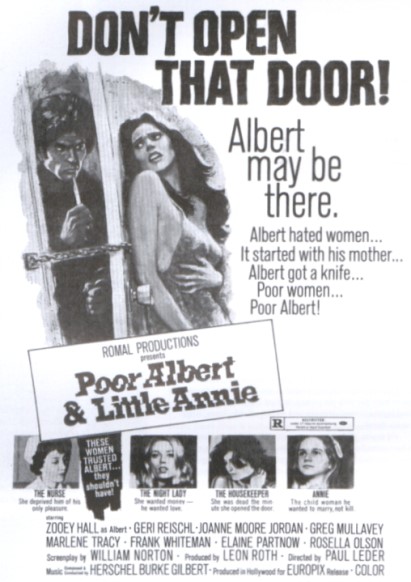
I Dismember Mama (1972): Poor Albert and Little Annie


"I Dismember Mama", aka "Poor Albert & Little Annie" (1972) has one of those notorious titles that I have always seen lurking on the outskirts of my awareness, on video shelves, in magazine articles, in catalogs...and all with no idea what kind of movie to which it was attached.  I decided to end this silly game that "I Dismember Mama" and I were playing with each other, and just walk right up and introduce myself. That was when "I Dismember Mama" turned around and whacked me up side of the head. I still haven't recovered.

Directed by Paul Leder, whose career I'm mostly unfamiliar with, "I Dismember Mama" is a low budget curiosity that is full of interesting photography, excellent performances by actors, and a memorably bizarre story. Although its cheapness shows through in almost every scene, it shows just as much art and inspiration as it does technical ineptitude and fragmented editing. If it hadn't featured such convincing performances by the leads, it never would have worked.
"Don't say that you love me, just tell me that you want me."
The first thing we see in the film is a man's face surrounded by darkness, next to a running film projector. The face belongs to Albert Robertson (Zooey Hall), who is currently in a mental hospital. A nurse comes in and interacts with him, gently scolding him with something like "Now Albert, you know you're not supposed to be watching these films..." and we assume these are what proper people refer to as "art films".  When she takes the film out of the projector, Albert goes from mildly irritated to violent in a split second, hurling the startled nurse onto a bed, ripping her clothes off and trying to strangle her. Orderlies intervene in the nick of time, but we immediately understand that Albert is screwed up like a soup sandwich, and appears to be in an institution ill-equipped to deal with him. Albert's doctor tells him Albert's there to deal with his feelings that "all women are whores," and he seems to fixate on his mother (Anne Marie Jordan) most of all. Albert has tried to knife her to death, and because of Albert's lack of remorse for his aberrant behavior, the doctor intends to send him to a state institution. See, Albert's mother is rich, and she has him in some private, low-security hospital, and Albert easily escapes by murdering an orderly.
"NO dear, don't take that Brady Bunch acting job, I'm warning you, it will kill your career."

From what we see of Mrs. Robertson, Albert had the right idea after all, as she seems like a self-absorbed snob. We see her talking down to her housekeeper, Alice (Marlene Tracy), and she blames Albert's outburst on his victim, the nurse, and she pooh-poohs the idea of sending Albert to an institution. She changes her tune though when Albert calls her and tells her he can hardly wait to see her. The police spirit her away to another house, but apparently it never occurs to them to put an officer at the main house. You know, the one Albert knows his mother lives in? When Albert shows up there later, he catches Alice packing her suitcase to leave.  In one of the movie's most disturbing scenes, he begins to torment Alice, threatening her with a knife for information about his mother, then ordering Alice to strip for him and perform a sexy dance. It's an intense scene, and one that both actors carry off expertly, especially Marlene Tracy. She's forced at knifepoint to strip and sing for Albert, and we can see in her eyes when Alice begins to realize Albert will certainly murder her. It's one of the most hair-raising things I've seen in a movie.

But the rest of the film is just as engrossing and disturbing. Alice's preteen daughter, Annie (Geri Reischel), comes home from school after Albert has killed her mother, and the dangerously disturbed Albert tells her that her mother had to go to the doctor because she was ill. After they hang out together for a while, Albert takes a liking to her and apparently decides not to kill her, instead spiriting her away on an idyllic day where they ride paddleboats and a small train. When Albert takes Annie to a hotel, his strange attraction to her starts to manifest itself. Instead of making a sexual advance toward Annie, Albert goes to a bar and picks up a woman there by flashing a little money around. We already know he's going to kill her, and Annie wakes up when it happens, escaping the hotel suite down the fire escape. Albert chases after her and pursues her in the film's climax, which finds them Annie lost in a strange, deserted back alley of the city. They wind up in a mannequin factory, where Annie tries to hide among the figures. Albert spots her though, and accuses her of being "just like all the others", attacking her with a convenient meat cleaver that just happens to by lying nearby. Annie, however, pushes a mannequin into him and he falls out a fourth story window onto the concrete.


"I Dismember Mama" actually doesn't feature any dismemberment, and eventually the mother is completely forgotten, so the title is nearly meaningless. This is probably one of the biggest problems that the movie has, since enough screen time is given to Albert's heartless mother that we start to care about whether or not he gets her, and we want him to. Although Albert is a compulsive murderer and rapist, we get the feeling that his mother is completely disassociated from reality, and she can't deal with the truth about Albert. There is also all sorts of ineptitude from the police, who aren't even coherent enough to guess that Albert might return home after escaping from the hospital. Even Albert's "doctor" is a shithead, openly defying the police investigation and refusing to tell Mrs. Robertson that Albert has killed her housekeeper.


"Lookin' out for looooove...."

But these unresolved plot threads are really superfluous anyway, since the film's centerpiece is Zooey Hall. His performance as Albert is as terrifying as David Hess from "Last House on the Left", but Hall endows the character with a likable side too, which really makes it upsetting when he lapses into his deranged behavior. The scene where he threatens Alice and makes her strip is really scary because he is so calm and collected during the whole thing, but his explosive violence in the other murders is just as scary. The terror of Albert is that he's obviously dangerously disturbed, yet he doesn't come up against anybody who can put him in check. The doctor he's assigned is unable to reach him, the hospital staff is unprepared to deal with him, and the victims he selects are seemingly unable to fight back against him. His interest in Annie, however, brings out a childlike side of himself, and it's hard not to feel pity for him when we see his momentary happiness. A lot of the tension, of course, depends on Annie being totally naive about the fact that she's in danger, not to mention that she is in the company of a man who apparently has pedophilic designs on her. After killing her mother, Albert takes her on a day of fun, then spends the night with her in a hotel, and in a bizarre sequence we see them conducting a mock wedding. Albert tells Annie that she's the only pure female he's ever known, uncorrupted by whatever issues he perceives about most women. In the hallucinatory chase through the mannequin factory at the end, surrounded by artificial female bodies in various stages of assembly, there's a moment when Albert finally spots her and sees her with cosmetics on, something we're never quite sure is real or not. This horrifies him and he immediately decides to kill Annie, using a meat cleaver that's conveniently lying nearby--in a mannequin factory! Only Annie's cleverness saves her; using a mannequin as a shield, she manages to push Albert out the window, the mannequin protecting her in the way an adult might protect a child from danger.


"I Dismember Mama" is extremely dated filmmaking, which either adds to or detracts from it, depending on the viewer. The glimpse into the social mores, design, clothes, decor, and attitudes of the 1970s is crucial to the experience, and there's even a ballad that plays over top of the montage where Albert and Annie have their fun day together. I loved one moment when a character was standing outside a hot dog shop that sold hot dogs for 19 cents. Viewers expecting gore will be disappointed, and with good reason in a film that was marketed until a title that features the word "dismember". There is a gory aftermath of a throat-slashing near the beginning, and a briefly glimpsed surface wound during a knife attack, but that's the extent. The original title is also misleading, though, and more than a little vague. I can't say that "I Dismember Mama" is a pleasant experience, but considering horror movies are meant to get under our skin, this one succeeded in spades with me. It is artfully disturbing and tastefully done, considering that it touches on themes of mental illness, sexual violence, and apparent pedophilia, and I won't forget it anytime soon.  Leder, who also was behind the awful 1976 giant monster spoof/ripoff movie "A*P*E", also made a sequel to "I Dismember Mama" in 1994 called "Killing Obsession", but as yet I haven't seen it, and I can't imagine how this doomy little movie could be improved upon. Forget the lack of gore; this is about as lurid, affecting, and engrossing that an exploitation film can get.


Friday, August 2, 2013

Mausoleum (1983): Touched by a Nomed...


Here's a wacky little flick that I had somehow avoided seeing all my life. It was heavily promoted in "Fangoria" and "Famous Monsters" around the time of its release, and I remember reading all about it and the much-hyped gory special effects. I guess it never played on HBO though, or if it did I missed it, and I never rented "Mausoleum" during the VHS boom. Boy, was I missing out, because "Mausoleum" is really one of a kind. A very...special kind.

Playboy model Bobbie Bresee plays a woman named Susan, whose mother died when she was just a young girl. It seems Susan's mother was claimed by some sort of curse visited on her family. In the opening scenes, we see Susan as a little girl at her mother's funeral, after which she takes off running from her aunt and finds herself alone in the graveyard next to a mausoleum with a strange, superimposed storm taking place around it. Traveling, mausoleum-specific weather is always a sign of supernatural activity, and when Susan inexplicably enters the mausoleum, her eyes glow green when she's confronted by a mostly-offscreen apparition that rises out of a grave marked "NOMED".  Yes. Absorb that for a moment, I'll wait. NOMED.

"Susan, come to our mausoleum rave! The code word to get in is NOMED."
Flash forward to when Susan is a beautiful 30-something who has inherited her family's fortune. Her life seems to consist of wafting around her giant house in sexy nightgowns and preparing dinner for her husband, Oliver (Marjoe Gortner).  She has a gardener named Ben (Maurice Sherbanee) and a maid named Elsie (none other than LaWanda Page), but something just isn't right with her life. Oh RIGHT...remember that incident in the mausoleum? THAT'S Susan's problem! She's falling victim to a family curse that affects all Nomed females, and her first lapse into a demonic tantrum makes her murder a lecherous Kenny Rogers lookalike who hit on her in a nightclub by telepathically making his car explode. This involves her eyes glowing green, just so we remember that she's possessed and not just an expert on mentally rewiring cars to explode on ignition.

"Did I leave the coffee pot on?"
Shortly thereafter, Susan ups the ante by seducing and murdering Ben the gardener, after a lengthy and utterly wacko sequence where we see him going about his daily chores, as well as napping and eating lunch. Why? We don't know, but I suspect it had something to do with padding the runtime of this movie into feature length. Poor Ben, although he is a creep, I can't get behind the idea of mauling him with a garden claw, which is what Susan does. Immediately after fucking him, of course, because she's apparently possessed by a lustful demon. The next to go is her aunt Cora, who only wants to drop off some "estate papers" Susan requested. Susan shows her a vicious demon face before telekinetically lifting her over a staircase landing and causing a fatal split to appear in her chest. Because "Mausoleum" exists in a wacky universe, the next scene shows Susan looking all beautiful and fashionable, hair elegantly styled, sitting on her couch in front of a roaring fireplace, casually reading a magazine. While wearing high heels. Oliver comes home and asks her what's for dinner, and she replies "Poached salmon...and ME." 
Ben and Susan engage in a strange, ancient ritual of exhibitionism...
Playing Van Helsing to Susan's demon is Dr. Andrews (Norman Burton), a shrink who has been treating Susan since she was a child. Of course he doesn't know she's possessed, and he isn't even concerned when Oliver calls him in the middle of the night and begs him to come over to the house because he saw Susan acting strangely ("It wasn't Susan!" he gasps). Andrews completely dismisses him and says "I think it's best we ALL get some sleep."  Eventually he decides to hypnotize Susan, and he meets the demon, which identifies itself as "Nomed!" Hold a mirror up to it if you haven't pieced it together yet. Simon calls his colleague Dr. Logan (Sheri Mann), and describes what happened to Susan as "vocal and facial fantasies". Apparently her eyes turning green and her teeth turning into Indian corn weren't enough to fully convince him anything supernatural was going on. Dr. Logan does believe it, especially when Andrews plays back an audio recording of Susan's demonic freakout, complete with the trilling horror movie soundtrack audio noise we heard when it happened (a meta moment for sure).  
Green eyed lady, corn-teethed layyy-deh!
Meanwhile, Susan continues her demonic rampage when a deliveryman stops by and she uses her sexy demonic ways to lure him inside the house. She doesn't even fuck this guy though, his face just melts when he uses the telephone. Another murder happens when Susan goes art shopping and the gallery attendant makes the mistake of refusing to sell her the strange painting she takes a liking to. She hovers him over a balcony like aunt Cora, then drops him to his death. Dr. Andrews schools Oliver on the logistics of demonic possession, using a diary that contains all the pertinent information to explain the plot (I'm not sure where the diary came from, but whatever). Dr. Andrews must return to the mausoleum and use a crown of thorns contained there to 'neutralize' the possession. Oliver naturally rejects the idea of demonic possession, forgetting the fact that earlier in the movie he called Dr. Andrews in the middle of the night saying "It wasn't Susan!" He pays for this disbelief when Susan embraces him while nude and then transforms into a demonic creature with ferocious demon breasts, which bite him and rip open his ribcage. Yes. Bobbie Bresee's Playboy boobs actually murder a character in the film. I bet you have never seen this kind of thing before, have you? HAVE you? Wait, never mind...you're not answering me, so obviously you have seen this kind of thing before and I don't really want to know.
"Miss Susan, don't you be messin' around that mausoleum..."
Dr. Andrews finds Susan in her attic, which is covered in so many movie cobwebs, this movie could have been about killer spiders and it would have been much scarier. After putting the crown of thorns on Susan's head, the demon leaves her and teleports back to the mausoleum. For some reason, Dr. Andrews drives Susan back there, where she confronts the creature as it crawls back into its vault and apparently dies. The end. But wait! The last shot of the movie shows Dr. Andrews talking to a hooded guardian, whom he admonishes "No one must ever go into the mausoleum!" Then it turns around and it's Ben, the gardener. WTF?
"Oliver, your wife is possessed, believe me. THIS is what a normal woman looks like. Well OK, maybe she's not the best example, but believe me your wife is possessed!"
I am doll parts....

OK so WOW, "Mausoleum"....it doesn't make any sense, but boy is it fun. The monster makeup is clearly the only reason the movie exists, and it's pretty good stuff. Bobbie Bresee also wears a number of demonic contact lenses and makeup appliances, and then there's a full inhuman creature that appears (the one with the killer breasts). There is some great cheesy lighting throughout the film, and you always know when there's some demon stuff happening because usually it is accompanied by a green and purple light show, along with lots of fog where no fog should be. At times, "Mausoleum" appears to be a horror comic come to life, with no attempt at realism at all. It has a bogus earnest tone to it, but the surreal parts reveal its true nature as a pure pulp fantasy film. There's a lot of intentional comic relief too, much of it involving LaWanda Page. At one point, she exclaims "No more grievin', I'm leavin'!" and escapes the house with her suitcase, proving that yes, only white people are silly enough to stick around when green light and fog is coming out of someone's bedroom. The fact that it's an absurd film is really the only thing that saves it, as it would have looked ridiculous anyway if it had been sincere. Bobbie Bresee appears nude several times, revealing why she was a Playboy model, and although she isn't much of an actress, her acting is completely appropriate for a movie like "Mausoleum." Marjoe Gortner's appearance in the film is a highlight, and if you don't know who he is, I would recommend checking out his Wikipedia page for a crash course in all things Gortner. His history as a former Pentecostal preacher (at age 4) is more interesting than anything in "Mausoleum", and you should also check out the 1972 documentary that was made about him called simply "Marjoe".

I also can't fail to mention that, although an 80s flick through and through, "Mausoleum" carries on a great 70s tradition of having a doomy ballad recorded just for the movie, "Free Again", which plays over the end titles. I am a sucker for things like this.

At the time of this posting, "Mausoleum" is available to watch for free on YouTube at the following link:

http://www.youtube.com/watch?v=f9QoUpskHa4


You must never let Susan near the sharp utensils, no matter how sexy her boobs are. Trust me on this.
"It really wasn't such a bad Nomed. I feel bad killing it..."


Tuesday, September 25, 2012

Squirm (1976): When things that can't kill you, can.


...and then suddenly, there were worms, everywhere! Wait, where was I, what was I saying? Sorry, sometimes a movie is just too close to my heart, and I don't know how to start these blog entries. Tonight's movie is about WORMS, and lots of them. As a child, I once owned a super-8 film projector, and I remember choosing a few movies out of a mail order catalog--yeah, this was in the late 70s, before VHS players were in every home, and way before movies like "Squirm" appeared on videocassette. But you could purchase films for your home projector, and much to my disappointment, the small Super-8 reels did not contain entire movies. Some of them were silent, and some were black and white even if the movie was originally in color. Fortunately, my super-8 reel of "Squirm" not only had sound, it was in full color, too. I can't remember if I read about it in "Famous Monsters" magazine first, or if I just picked it because of the title, but the blurb said it was about killer worms, and that was weird enough for 9 year old me. What I got when "Squirm" unreeled in the projector was a 15 minute highlight reel of what I was sure was the most revolting movie ever made. I remember making everybody I knew watch the movie, and I once terrorized a sleepover of girl scouts by being invited to show them cartoons and instead subjecting them to a movie where worms consumed human flesh before their very eyes. Lucky for them, it only ran about 15 minutes. Lucky for me, nobody beat my ass for it.

"Squirm" is an AIP International picture, directed by Jeff Lieberman ("Just Before Dawn", "Blue Sunshine"), where New York city boy Mick (Don Scardino) journeys by bus to the tiny hamlet of Fly Creek, Georgia, to visit a girl named Geri Sanders (Patricia Pearcy). Geri lives with her wannabe-hippie sister Alma (Fran Higgins) and their freaked out mother Naomi (Jean Sullivan). His arrival is preceded by a violent electrical storm--a solemn text crawl opens the film by telling us that 'scientists' recorded a bizarre freak of nature in Fly Creek--and the collapse of an electrical tower renders the town dark and sends the voltage "surging into the muddy ground".

Mick immediately draws attention to himself in Fly Creek by mouthing off to a local diner waitress when he orders an egg cream (some fancy hipster drink she's never heard of) and then finds a large sandworm in it. Instead of apologizing, the waitress acts all offended, and the sheriff (Peter MacLean) gets in Mick's face and practically tells him to leave town. You know, just like any small town sheriff wants to do, right?

Geri's an aspiring antique dealer (we're to believe she met Mick at some kind of flea market or swap meet), and she drags Mick to meet another local salesman, but instead they find his place abandoned and a human skeleton lying near his shed. What they don't know is that he was eaten by worms. I mean, the audience already knows, because they bought a ticket to a movie called "Squirm" that has been advertised as a movie about worms eating people, so naturally you understand the man was killed by worms, but Fly Creek is a place where the worms look like this:
Yes, they have teeth, and they bite. They also make screaming noises, which the movie never explains, but it's the bitey parts we're afraid of. So we want to see these damn things BITE somebody. The first time they do, it's a pretty big moment. Geri winds up in a rowboat with Roger (R.A. Dow), a somewhat ominous lunkhead who is CEO of the Geri Sanders Fan Club. But Geri only has eyes for this new fella Mick, some city wimp, so Roger feels threatened. When Mick conspires to leave the two of them alone so he can go check the dental records of the skeleton, Roger puts the moves on Geri and tries to kiss her. When she knocks him over backwards (which is a bad idea when you're in a rowboat with somebody, but never mind), he falls directly onto a pile of slithering worms they've been using for bait. The worms attack him and in the film's most notorious scene, they burrow directly into his face, crawling underneath his skin in gory detail. It's the stuff of nightmares!
Poor Roger just ain't the same after this experience. He runs off into the woods screaming, leaving Geri to find her own damn way back home. Mick and Alma deduce that the skeleton belongs to Geri's antiques dealer friend, and Mick discovers Roger's father, Willie (Carl Dagenhart), dead with a ribcage full of worms. Through the miracle of standard plot developments, they can't get the sheriff to believe them about the fact that worms are attacking people, and they're on their own to figure out what the hell you do when worms come after you. Mick pieces together the remaining element to this mystery they're working on: the worms can't stand the light. It's an important rule in the "Squirm" universe: light = no worms. Darkness = more worms than you would care to imagine.
A little of what Mick's having makes this movie even more enjoyable.
Meanwhile, at the Sanders home, things start to get wormshit crazy: worms have apparently invaded the local plumbing, and when Alma turns on the water in the shower, nothing comes out. Well, nothing except for worms, that is...when she turns around and leaves, worms begin pouring out of the showerhead and filling up the tub, then the entire room. When a tree collapses and compromises the security of the house, Mick runs off into the woods to get some plywood and is attacked by Roger, who incapacitates him by knocking him unconscious and leaving him for worms to eat. Roger then goes back to Geri's house to do some serious lurking, which is what you do when you've got worms for brains. He ties Geri up and somehow ushers her into the attic. Alma has already discovered the bathroom filled to the ceiling with worms, which pour out in a flood when she unwittingly opens the bathroom door. It is at this point in the film we assume Alma has checked out after her worm shower.

"Oh great, now the worm bill is really going to be out of control this month..."
Mick returns to the house, using a convenient branch to light his conveniently flammable shirt and make a convenient torch, which causes the hordes of worms to retreat in the light it gives. He finds Mrs. Sanders to be a writhing pile of worms, and is then attacked by Roger, who chases him back downstairs. The entire lower floor of the house is now a literal sea of worms, which Mick manages to throw Roger into, presumably solving the Roger problem for good. But when Mick and Geri try to climb out the window into a nearby tree, Roger comes crawling out of the worms for one last attack, at which point he seems to have become a worm himself.
Never let a man like this near your worm, never.
After beating Roger to death with a flashlight, Mick holes up with Geri in the tree all night. The next morning, the worms are all gone, and a telephone repairman wakes them up by yelling up to them that the phones are working again. Apparently in these parts, seeing a couple asleep in a tree isn't unusual enough to make a man think something's wrong. In a happy happy ending, we discover that Alma has saved her own life by hiding in a large trunk, which was apparently not only empty, but worm-proof, too. Now if only Mrs. Sanders wasn't a writhing pile of worms, everything would be truly alright.

Lieberman shows us a number of upsetting things in the film, and that wormface gag isn't the only one. The sheer volume of worms used in the movie had to be astronomical, and seeing the sets inundated with worms is disturbing. One moment has the sheriff and his girlfriend screwing in an empty jail cell and being attacked by worms, which pour in through the windows. Another standout moment has the local dive bar, Quigley's, swamped with worms, which people immediately leap off of their bar stools into. One far out Fly Creek chick plays it smart and climbs up onto the bar, where she does a sort of scream-dance. It's wild!

There is more to it than just the shock sequences, though, including a very strong Southern gothic feel to the film. Jean Sullivan channels Jessica Tandy's performance in "The Birds" as a mother figure on the verge of losing her grip, and she adds her own twist to the characterization. She's a little spacier than Tandy was, a little more disconnected, and by the time she's a pile of worms, she seems to have completely lost touch with reality, continuing to work on her knitting while worms drop from the ceiling into her living room. The character actors all do a great job in communicating the atmosphere of a small Southern town, and in fact many of the secondary characters were locals in the town where the movie was actually shot (Port Wentworth, Georgia). The scene where Mick goes into a local drug store and is eyed suspiciously by the locals is one of the film's highlights, especially the lunch counter waitress who loses her patience with him when he spills a drink on her counter.

But the best thing about "Squirm"--other than the fact that it's about A FREAKIN OCEAN OF MAN EATING WORMS--is how ultra 70s it is. Not only are there wacky bell-bottoms galore, but there's a doomy love ballad in the film, a strange custom that I can't relate to but I love just the same. It also has the cartoonish sense of humor of a 1950s monster movie, something that seems to have been overlooked when it was featured on Mystery Science Theater--no really, we think these goofy things in the movie are intentional, guys.

Watching the full length film is surreal for me, because the scenes that were contained into that original Super-8 edited version are forever burned into my brain. That edited version illustrates the only thing "Squirm" is really guilty of, which is a runtime just a little too long for its subject matter; its first and second acts are slowly paced, and we watch the main characters unravel a mystery about a secret we already know. However, that worm attack in the boat is more than enough to make up for that, not to mention the various worm agonies inflicted on R.A. Dow's character throughout the rest of the movie. I doubt I could ever forget those images of him being sucked underneath a sea of writhing worms and the effect they first had on me. Also, somewhere there's a dispersed group of former girl scouts who all grew up to be pathologically afraid of worms.
"...anyway, there we were watching cartoons, and all of a sudden this thing with WORMS comes on..."