Welcome to the wacky world of "Invasion of the Bee Girls", where certain honeys are more than they seem to bee, and even the very act of sexual intercourse can result in your death at the...hands?...of a woman mutated with the genetic material of bees. Hear me, true bee-lievers, it could happen to you just like it did in Peckham, California. Let me tell you all about it.
"Don't look right away, but that woman behind us....why does she have her sunglasses on inside?"
Neil Agar (William Smith, "Grave of the Vampire", "Maniac Cop") is a state agent investigating the death of a bacteriologist who was found dead in a cheap motel room. The scientist was associated with the Brandt Research center, a government-sponsored lab in the small town of Peckham, and his death seems to have been caused by a heart attack that occurred during a moment of sexual intercourse. His female partner is unknown. Before Agar can decide the death isn't suspicious after all, more bodies start turning up that look a lot like this:
It seems that Peckham has a strange epidemic on its hands, and the exclusively male victims all suffer the same symptoms: fatal thrombosis during sexual intercourse. Neil meets the Brandt center's chief librarian Julie Zorn (Victora Vetri, "Rosemary's Baby"), who tips him off about the important scientists working at Brandt. The sudden rash of deaths has the locals panicked, and by "locals" I should say stereotypically piggish semi-thugs who do things like sexually assault women in alleys, attend rabble-rousing union meetings and drink a lot of beer. The local sheriff holds a town meeting to warn everyone to be celibate, although the men are not about to put on any purity rings, and more of them wind up dead after coming into contact with several suspiciously beautiful women who like to wear large dark sunglasses. At night. Brandt's sex expert, Henry Murger, announces that he has a bizarre theory to explain the deaths, but he is conveniently run over by a car with a mysterious (and we presume beautiful) driver before he can meet with Neil and Julie to discuss his theory.
They also have this suspect honeycomb-vision, accompanied by a buzzing sound.
Your showcase contains this beautifully complicated instrument panel, essential for any world domination plot!
The figure who keeps appearing in the background at all these points of interest is Dr. Susan Harris (Anitra Ford), a lovely entomologist whom the horny male scientists describe as an 'iceberg'. It's not long into the movie where we start to realize women are deliberately and literally screwing these men to death, usually after they reveal that their eyes have turned completely black. This naturally never deters any of the men from screwing them, leading to this epidemic of sexually exhausted male corpses. Neil discovers that Murger, the one man not to succumb to this strange phenomenon, was gay and had a secret male lover. Could this bee the reason someone had to resort to the more patently boring method of vehicular homicide?
"Would you like some coffee with that sugar, Dr. Harris?"
Ha! Now my sunglasses are actually ON my EYEBALLS.
Another scientist named Herb Kline falls victim when Susan Harris suddenly warms up to him and invites him to her house for dinner, where she seduces him and then kills him with sex, her eyes turning black. SHOCK-she's ONE of them! Well, not only is she one of them, she's the creator of them! Harris has developed a way to transform ordinary women through a process of controlled mutation. After Kline is dead, she phones Mrs. Kline and lures her to her laboratory, where she has this strange hive-like dome equipped with what appear to be giant ray guns. Harris and the other "bee girls" force Mrs. Kline into their bee-o-dome (har har) and bombard her nude body with gamma rays, a gooey substance that looks suspiciously like marshmallow topping, and the final key ingredient: a swarm of irradiated bees. After her transformation is complete, her eyes are black too, and we presume she is now equipped with a killer bee-vagina like the others. Hvvvvvvvvvvvv....
So that's how it is in their hive....
Stay calm, sheriff...don't bother her and she won't bother you.
After Mrs. Kline becomes part of this insidious insect plot, the sheriff goes to inform her of her husband's death, at which point she attempts to seduce him right then and there while he's telling her about it. Perhaps only her bizarre sense of timing foils the plan by spooking the sheriff, who bolts. Proving that a bee girl is not invulnerable is another incident where Brandt geneticist Stan Williams is attacked by his recently transformed wife, but he manages to strangle her with her own stocking before he dies, resulting in one of the most bizarre crime scenes that any investigator has ever stumbled upon:
It's all about to come to an abrupt end for Dr. Harris and her bee girls, however, bee-cause super agent Neil is hot on their trail, assisted by the lovely librarian Julie. Neil connects all the dots in the nick of time and races back to Harris's lab, where Harris and her deadly women have kidnapped Julie and are attempting to turn her into one of them. Neil rescues Julie and fires a bullet into Harris's bee-machine, breaking it and saving the day. The bee girls die, and the mating process in Peckham can finally go back to normal.
Although it doesn't really work as a horror movie or even a science fiction film, "Invasion of the Bee Girls" is a true gem, a wild time capsule full of 1970s decor, politics, and attitudes. Like "The Stepford Wives" which came a few years after, this movie makes a dark satire about the power struggle between men and women of this era, seemingly stoking men's fears that women were gaining the upper hand and had malicious intent once they gained power. Anitra Ford is great as the film's female villain, although the script doesn't really bog down with too many details, ensuring that her character remains a cipher. The film is lacking a scene where she explains her motivation for doing what she's doing, leaving us to draw our own conclusions. The movie plays it safe by making both sides of the issue into caricatures; although the obligatory romance blossoms between Neil and Julie, when they first meet she gives him an unsmiling, hostile greeting. Dr. Harris herself is the very definition of a frigid bitch, warming up only when it's time to seduce a man and kill him. The men in the movie are almost all foolish boors--the local townspeople are even depicted as sexually aggressive and violent, and there's a scene where no less than four of them attempt to gang rape Julie. The Brandt scientists are not much better, despite being stuffy brainiac types. Even when men are dropping dead after having sex, they are rendered powerless by any woman who wears provocative clothes. I found it hilarious that the bee girls had to run over Murger with a car because he was gay and therefore immune to their seductive charms, but did the movie have to tell us this via a scene where Neil finds a secret sex room in Murger's house, full of whips, chains, crossdressing items, greek statues, caged birds, an aquarium, and...lava lamps? Who knew a blue lava lamp meant you were gay? Hey, I love lava lamps, so maybe it's true. Hmm!
Any high-tech laboratory is not complete without an ice cream cooler.
It's best not to think about these things too much though when you're watching a B movie (get it?), and my only real complaint with "Invasion of the Bee Girls" is the abrupt, lifeless conclusion. Despite being completely outnumbered by about 10 to 1, Neil is able to easily infiltrate Dr. Harris's lab--she doesn't even lock the door--when Julie is in danger of being transformed. Not only that, all he has to do is fire a single shot into the giant instrument panel and the ENTIRE HIVE is conveniently killed. Dr. Harris is one of the most fascinating characters in the movie, but we know so little about her. It's disappointing that when she's faced with the complete undoing of her evil scheme, she can't even muster up the strength to fight back. Considering she's a mad scientist, she could have at least had a scene where she proclaims her manifesto. Since her vendetta is against men, it would have been interesting to hear her views firsthand. But the worst indignity the movie heaps on her is her death scene. OK, I get it...she's a mad scientist. She wants to take over the world (or at least Peckham) by murdering all the men. She must be stopped, which in horror movies means she must die. But couldn't they have at least given her a spectacular death scene? Did she die when someone threw her into a bubbling cauldron of molten beeswax? Did she get accidentally sealed inside a honeycomb and asphyxiate? Was she burned alive while being embraced by the spirit of Joan of Arc? No, actually this happens:
She just sort of stands there in a daze while her bee-o-dome goes up on a flurry of sparks, and then she is engulfed by a bloom of white light (radiation?), after which she scratches her own face and collapses.
Not very fitting for a mad genius, I say. I liked Dr. Harris, even if she was a little more Valerie Solanis than Naomi Wolfe.
"Invasion of the Bee Girls" doesn't have much in the way of horror, with the exception of the murder of Henry Murger, during which an unseen Harris drives a car into him and crushes his midsection, then while he is lying on the ground dying, violently crushes his entire body by running right over him. There are a lot of beautiful naked women of varying ages and body types, and if this movie had been made in 2013, there wouldn't be a bee girl over the age of 23 in the film. One of the sexiest women in the movie is Beverly Powers, who appeared as Beverly Hills in "Brides of Blood". Beverly was in her mid 30s when she made "Invasion of the Bee Girls", and her character is made to appear slightly older than that, but her seduction scene is one of the best in the film: earlier in the film we see her putting cold cream on her face while snapping at her husband before bedtime, and after being transformed she performs an erotic strip tease for him. Anitra Ford is an interesting lead as well, she has an exotic quality to her and her limited dialogue in the film makes her seem even more mysterious.
I really must have that mirror for my own. My life may depend on it.
Technically, "Invasion of the Bee Girls" is about what you'd expect for a cheap exploitation film from the 1970s. The film stock is often grainy, the editing sometimes rough, and there's nothing in the way of special effects that will make you say "Wow, man!" But the cinematography is endearingly 70s, with a lot of zooms and focus pulls. The decor is even more outrageously, wonderfully dated, as are the clothing and hairstyles of the male characters. The soundtrack is a lot of wakka-wakka funk, especially one piece that features frantic ethereal "bee girl" vocals that sound like a nightmarish B-side (bee side?) to the Three Degrees "When Will I See You Again".
Furthering my love for "Invasion of the Bee Girls" is the fact that it was re-released in the early 1980s as a double-bill second feature under the title "Graveyard Tramps". I can't imagine where the hell anybody came up with that title, as only one scene in the movie takes place in a graveyard and that's during a funeral--but I love it.
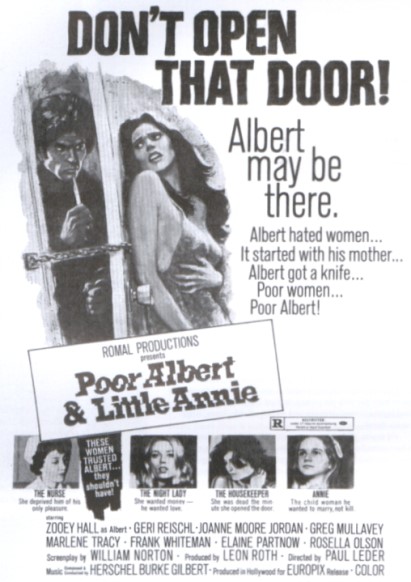
"I Dismember Mama", aka "Poor Albert & Little Annie" (1972) has one of those notorious titles that I have always seen lurking on the outskirts of my awareness, on video shelves, in magazine articles, in catalogs...and all with no idea what kind of movie to which it was attached. I decided to end this silly game that "I Dismember Mama" and I were playing with each other, and just walk right up and introduce myself. That was when "I Dismember Mama" turned around and whacked me up side of the head. I still haven't recovered.
Directed by Paul Leder, whose career I'm mostly unfamiliar with, "I Dismember Mama" is a low budget curiosity that is full of interesting photography, excellent performances by actors, and a memorably bizarre story. Although its cheapness shows through in almost every scene, it shows just as much art and inspiration as it does technical ineptitude and fragmented editing. If it hadn't featured such convincing performances by the leads, it never would have worked.
"Don't say that you love me, just tell me that you want me."
The first thing we see in the film is a man's face surrounded by darkness, next to a running film projector. The face belongs to Albert Robertson (Zooey Hall), who is currently in a mental hospital. A nurse comes in and interacts with him, gently scolding him with something like "Now Albert, you know you're not supposed to be watching these films..." and we assume these are what proper people refer to as "art films". When she takes the film out of the projector, Albert goes from mildly irritated to violent in a split second, hurling the startled nurse onto a bed, ripping her clothes off and trying to strangle her. Orderlies intervene in the nick of time, but we immediately understand that Albert is screwed up like a soup sandwich, and appears to be in an institution ill-equipped to deal with him. Albert's doctor tells him Albert's there to deal with his feelings that "all women are whores," and he seems to fixate on his mother (Anne Marie Jordan) most of all. Albert has tried to knife her to death, and because of Albert's lack of remorse for his aberrant behavior, the doctor intends to send him to a state institution. See, Albert's mother is rich, and she has him in some private, low-security hospital, and Albert easily escapes by murdering an orderly.
"NO dear, don't take that Brady Bunch acting job, I'm warning you, it will kill your career."
From what we see of Mrs. Robertson, Albert had the right idea after all, as she seems like a self-absorbed snob. We see her talking down to her housekeeper, Alice (Marlene Tracy), and she blames Albert's outburst on his victim, the nurse, and she pooh-poohs the idea of sending Albert to an institution. She changes her tune though when Albert calls her and tells her he can hardly wait to see her. The police spirit her away to another house, but apparently it never occurs to them to put an officer at the main house. You know, the one Albert knows his mother lives in? When Albert shows up there later, he catches Alice packing her suitcase to leave. In one of the movie's most disturbing scenes, he begins to torment Alice, threatening her with a knife for information about his mother, then ordering Alice to strip for him and perform a sexy dance. It's an intense scene, and one that both actors carry off expertly, especially Marlene Tracy. She's forced at knifepoint to strip and sing for Albert, and we can see in her eyes when Alice begins to realize Albert will certainly murder her. It's one of the most hair-raising things I've seen in a movie.
But the rest of the film is just as engrossing and disturbing. Alice's preteen daughter, Annie (Geri Reischel), comes home from school after Albert has killed her mother, and the dangerously disturbed Albert tells her that her mother had to go to the doctor because she was ill. After they hang out together for a while, Albert takes a liking to her and apparently decides not to kill her, instead spiriting her away on an idyllic day where they ride paddleboats and a small train. When Albert takes Annie to a hotel, his strange attraction to her starts to manifest itself. Instead of making a sexual advance toward Annie, Albert goes to a bar and picks up a woman there by flashing a little money around. We already know he's going to kill her, and Annie wakes up when it happens, escaping the hotel suite down the fire escape. Albert chases after her and pursues her in the film's climax, which finds them Annie lost in a strange, deserted back alley of the city. They wind up in a mannequin factory, where Annie tries to hide among the figures. Albert spots her though, and accuses her of being "just like all the others", attacking her with a convenient meat cleaver that just happens to by lying nearby. Annie, however, pushes a mannequin into him and he falls out a fourth story window onto the concrete.
"I Dismember Mama" actually doesn't feature any dismemberment, and eventually the mother is completely forgotten, so the title is nearly meaningless. This is probably one of the biggest problems that the movie has, since enough screen time is given to Albert's heartless mother that we start to care about whether or not he gets her, and we want him to. Although Albert is a compulsive murderer and rapist, we get the feeling that his mother is completely disassociated from reality, and she can't deal with the truth about Albert. There is also all sorts of ineptitude from the police, who aren't even coherent enough to guess that Albert might return home after escaping from the hospital. Even Albert's "doctor" is a shithead, openly defying the police investigation and refusing to tell Mrs. Robertson that Albert has killed her housekeeper.
"Lookin' out for looooove...."
But these unresolved plot threads are really superfluous anyway, since the film's centerpiece is Zooey Hall. His performance as Albert is as terrifying as David Hess from "Last House on the Left", but Hall endows the character with a likable side too, which really makes it upsetting when he lapses into his deranged behavior. The scene where he threatens Alice and makes her strip is really scary because he is so calm and collected during the whole thing, but his explosive violence in the other murders is just as scary. The terror of Albert is that he's obviously dangerously disturbed, yet he doesn't come up against anybody who can put him in check. The doctor he's assigned is unable to reach him, the hospital staff is unprepared to deal with him, and the victims he selects are seemingly unable to fight back against him. His interest in Annie, however, brings out a childlike side of himself, and it's hard not to feel pity for him when we see his momentary happiness. A lot of the tension, of course, depends on Annie being totally naive about the fact that she's in danger, not to mention that she is in the company of a man who apparently has pedophilic designs on her. After killing her mother, Albert takes her on a day of fun, then spends the night with her in a hotel, and in a bizarre sequence we see them conducting a mock wedding. Albert tells Annie that she's the only pure female he's ever known, uncorrupted by whatever issues he perceives about most women. In the hallucinatory chase through the mannequin factory at the end, surrounded by artificial female bodies in various stages of assembly, there's a moment when Albert finally spots her and sees her with cosmetics on, something we're never quite sure is real or not. This horrifies him and he immediately decides to kill Annie, using a meat cleaver that's conveniently lying nearby--in a mannequin factory! Only Annie's cleverness saves her; using a mannequin as a shield, she manages to push Albert out the window, the mannequin protecting her in the way an adult might protect a child from danger.
"I Dismember Mama" is extremely dated filmmaking, which either adds to or detracts from it, depending on the viewer. The glimpse into the social mores, design, clothes, decor, and attitudes of the 1970s is crucial to the experience, and there's even a ballad that plays over top of the montage where Albert and Annie have their fun day together. I loved one moment when a character was standing outside a hot dog shop that sold hot dogs for 19 cents. Viewers expecting gore will be disappointed, and with good reason in a film that was marketed until a title that features the word "dismember". There is a gory aftermath of a throat-slashing near the beginning, and a briefly glimpsed surface wound during a knife attack, but that's the extent. The original title is also misleading, though, and more than a little vague. I can't say that "I Dismember Mama" is a pleasant experience, but considering horror movies are meant to get under our skin, this one succeeded in spades with me. It is artfully disturbing and tastefully done, considering that it touches on themes of mental illness, sexual violence, and apparent pedophilia, and I won't forget it anytime soon. Leder, who also was behind the awful 1976 giant monster spoof/ripoff movie "A*P*E", also made a sequel to "I Dismember Mama" in 1994 called "Killing Obsession", but as yet I haven't seen it, and I can't imagine how this doomy little movie could be improved upon. Forget the lack of gore; this is about as lurid, affecting, and engrossing that an exploitation film can get.
Let's hear it for "The Hand", one of the best movies ever made about a crawling hand. Well, no, let me rephrase that: what I meant to say was, "The Hand" kinda sucks. It was 1981, the year of such other great horror movies as "The Howling", "An American Werewolf In London", "Evil Dead". So, what the hell is "The Hand"'s problem? Why couldn't it get with the program?
Well, for one thing, it's hard to be a good movie when the movie's about a crawling hand. It's just not really all that scary. "Oh, there's a hand crawling on the ground? Well that's really weird, step on it. Or run over it with a lawn mower. Or, just put a laundry basket over it and put a heavy book on top to hold it in place." What damage can a crawling hand do? In "The Hand", it not only crawls, but it seems to teleport right onto the necks of its victims.
Michael Caine is a cartoonist married to a woman who talks like one of the "NPR girls" from Saturday Night Live. Their house in the country is getting on her urbane nerves, and she wants to take an apartment in New York City. What she fails to tell him is that she intends to take her daughter and move there without him. In what is possibly the movie's only truly effective scene, they're setting out for NYC to look at a potentially fabulous apartment to rent. NPR woman is driving, and she has an unfortunate case of road rage that results in an accident that severs Michael Caine's hand. Blood everywhere!
At that point, the movie could probably end, because that's probably what you'll remember most after watching "The Hand". Caine gets a prosthetic hand to replace the one that's currently rampaging through his life, but his days of cartooning are over. He leaves town and takes a job teaching, meets a biker chick and begins an affair, makes a sleazy friend, and is stalked by his crawling disembodied hand. I think we're supposed to dread and/or anticipate the moments when the hand might appear and strangle somebody, but honestly it only happens a few times. And get ready for some massive spoilage...I mean really, I'm going on a spoiling rampage here: it turns out that the hand didn't really do anything, it was really MICHAEL CAINE doing all the strangling. Bet you didn't see that one coming, did you? You probably won't see the twist-twist ending coming, either, where the hand really does choke a doctor to death while Caine watches (Viveca Lindfors, who had a much more enjoyable cameo role in "Creepshow" the following year as dotty old Aunt Bedelia).
I'm not sure what Oliver Stone was going for with this one. I can't even speculate as to how much cocaine he was doing at the time, because "The Hand" isn't crazy enough to indicate anybody was having any fun at all. I admit, a crawling hand is a creepy idea, and they can be fun for a brief moment, like in "Evil Dead 2". I remember a crawling hand in that all-time TV classic "The Eye Creatures", and that scared me when I was about 8. Oh, and Christopher Lee fell prey to a severed hand in "The House That Dripped Blood". But crawling hands aren't really scary enough to carry their own movies, and even though it is very talky, "The Hand" was definitely promoted as a horror movie. It got coverage in "Fangoria", I remember reading about it and seeing shots of the gruesome hand effects, both Michael Caine's bloody stump and the crawling demon itself. But ultimately, "The Hand" comes off just like its title villain: it's no big deal.
The 7th annual Drive-In Super Monster-Rama is over, and what a wild couple of nights it was. There's something about these events that really is like going back in time, and this year the Riverside really went all out and decorated the place a little extra spooky, including a haunted graveyard just outside the snack bar. Perfect for this year's Peter Cushing celebration!
Eeeyaaaaah!
Friday night's lineup began with "Brides of Dracula", Hammer's 1960 sequel to their original 1958 "Dracula" starring Christopher Lee (known in the US as "Horror of Dracula"). "Brides of Dracula" doesn't have Christopher Lee in it, as a voiceover narration reassures us that Count Dracula is indeed dead. However, Cushing is back as Van Helsing, and this time he investigates another outbreak of vampirism in Transylvania, propagated this time by a certain Baron Meinster (David Peel). As the film opens, Meinster is being kept chained in his castle by his mother (Martita Hunt), who is in the habit of bringing young girls to the castle so that they may be his victim. This time, though, Meinster convinces the girl to unchain him, and he's on the loose once more. Cushing is great as usual in this, only the second time he ever played Van Helsing, and the story isn't bad at all. It's easy to see why they brought Drac back for the next one though, as Christopher Lee's presence is sorely lacking.
1969's "Frankenstein Must Be Destroyed" is another one I've missed all these years, and it's one of the stronger Frankenstein entries I've seen yet. Cushing's Dr. Frankenstein returns yet again to continue his experiments, which always seem to change with each movie. In the first he pieced together a body from various parts and brought it to life. In "Frankenstein Created Woman", he had a method of trapping a person's soul and implanting it into another body. Now in "Frankenstein Must Be Destroyed", he is working on brain transplant techniques, with a colleague that somehow we've never heard about in all the other films. His colleague, Dr. Brandt, is in an insane asylum, which leads Frankenstein to break him out and transplant his brain in order to cure his insanity. This was one of the more disturbing Hammer "Frankenstein" films I've seen, as the actors were all very good and mostly convincing. The 'creature', which is of course Dr. Brandt's brain in another man's body, is compelling because once his brain has been transplanted he's treated like a monster, even though he's perfectly rational and otherwise normal. It's a gruesome idea but also really scary on an existential level--is everything we are contained in our brains? Is that where "we" live? Would we still feel the same if we were in another body? Hammer's Frankenstein movies are always bleak and gory, but they sometimes poke your brain a little, too.
1972's "Fear in the Night" was another film I was completely unfamiliar with. One of the weirder Hammer films, this one was about Peggy (Judy Geeson), a young woman recovering from a nervous breakdown who meets a man named Robert (Ralph Bates) and marries him. Before she can leave to move in with him, she is attacked in her apartment by a man with a prosthetic arm who tries to strangle her. After she recovers from that incident, she moves in with her new husband at the remote boys school where he serves as an instructor. She quickly discovers something eerie is going on, since there don't seem to be any students. Cushing is the mysterious headmaster who happens to have a prosthetic arm, and soon after she arrives at the school, she is once again attacked by the mysterious figure. Joan Collins also appears as Cushing's icy wife, and now you can probably see exactly where the story goes. I really got into this film's atmosphere, although it wasn't perfect. The plot was a little obvious, with some strong similarities to "Diabolique", and something about the whole movie doesn't click, although Cushing does give an effectively ambiguous performance.
The final feature for Friday night was "From Beyond the Grave", a 1974 anthology film from Amicus Films. I was thrilled that our print featured one of the film's alternate titles, "The Creatures". Cushing is a shopkeeper with an antiques store known as Temptations Ltd, and the four segments of the film focus on different customers who attempt to cheat him in some way and suffer cruel fates because of the cursed items they've purchased. Although it's got some great atmospheric cinematography and sets, the stories are a little dull, especially a humorous one about a man who consults a medium to get rid of an invisible demonic entity perched on his shoulder. The best story is the first, in which a young man buys a large ornate mirror containing a ghastly apparition that compels him to kill people.
Saturday night's program was even better, kicking off with "Madhouse", another Amicus picture starring not only Peter Cushing, but Vincent Price and Robert Quarry. If Christopher Lee had somehow made an appearance in the movie, nirvana may have been reached. "Madhouse" is a morbid slasher film in which Price stars as a horror movie actor named Paul Toombes. Paul suffers a breakdown when his fiance is murdered just before their wedding, her head cut off and then reattached to her shoulders so that when Paul comes up behind her and tries to kiss her, it falls off onto her dressing table. Due to a blackout he suffered before the incident, Paul is not sure whether or not he committed this crime. He's acquitted of the murder, but confined to an institution for over a decade. Upon his release, he resumes his horror career playing the same character, and murders start happening again, with the victims killed in exactly the same way as characters in Paul's films. Although it sounds like a plot that's been done many times before, "Madhouse" is actually a lot better than the premise itself. There's a glaring absence of gore and any actual violence in the film is tame and fairly bloodless (especially the opening decapitation), but the bizarre plot features a number of creepy ideas, such as a former actress that Paul worked with who suffers her own cruel fate while Paul is institutionalized and emerges as a burn victim living in self-imposed exile in a basement with a bunch of spiders that she keeps as pets.
"David, press that button David. Did you hear me David? David? David!"
"At the Earth's Core" from 1976 was another flick I'd never seen before, and what a hoot it was. Cushing stars alongside Doug McClure ("The Land that Time Forgot", "The People that Time Forgot", "Humanoids from the Deep") as a daffy scientist who creates a manned vehicle to drill through the Earth's crust. He and his assistant, David (McClure) wind up going too far and find themselves in an underground cavern fed by volcanoes and containing a number of bizarre prehistoric monsters and human tribes. The story, from a novel by Edgar Rice Burroughs, is quite simply ridiculous, and so are the special effects. This was not a problem for me though, and I loved this movie in the same way I love the movie "Infra Man" and other monster flicks that had a less-than-stellar budget. The thing that irritated me about "At the Earth's Core" was the script, which contained countless utterances of "David!" from Cushing. "David! Look at this plant! David! Look out! Look over here, David! David! David!" At one point, he cries out "David!" and somebody whips him for it, and I felt a momentary sense of happiness wash over the audience.
The third Saturday feature was "Asylum", shown here under its 1980 American re-release title "House of Crazies". A young doctor arrives at a rural insane asylum to interview for a position, and is given a challenge: he must visit with the asylum's four patients and decide for himself which of the four are the mysterious Dr. Starr, former director of the institution who has gone mad and become a patient. The four stories contained here are much more weird and unexpected than "From Beyond the Grave", with the exception of a silly dual personality story starring Charlotte Rampling that you can see coming from a mile away. But nothing could really prepare you for the opening story, in which a philandering husband and his mistress (none other than Barbara Parkins) plot to murder his wife. The husband chops her up into little pieces, wraps the body parts in brown paper and stores them in a freezer in the basement. Thanks to the wife's interest in black magic, the body parts become reanimated and attack both of them, strangling the husband and attacking Parkins when she arrives at the house. "Asylum" really works because the wraparound story is a good one too, with a genuinely creepy moment when the elusive Dr. Starr murders someone, leans over the body with a stethoscope and listens for a heartbeat, then lets out this hair-raising insane laughter.
The final movie of the weekend was the one I was most anxious to see, 1977's "Shock Waves". I discovered "Shock Waves" years ago on home video and immediately fell in love with it. A small group of tourists on a chartered yacht encounter a strange phenomenon when their compasses go haywire, the sky turns orange, and they are later rammed by what appears to be an immense ship. When dawn comes, they learn the ship that hit them is a rusted out wreck on the reef of a nearby island. Forced to leave the boat due to the damage from the ship, the party soon learns that they're being stalked by a group of waterlogged zombies, products of a German experiment to create unkillable soldiers for use in World War II. The commander of the project, played by Peter Cushing, is the only inhabitant of the island, living in self-imposed exile. The return of the ship, and the return of the zombies, signals the end for him and anybody else who can't escape the island in time. "Shock Waves" suffers from poor editing and pacing, along with muddled motivations. Countless times we see the zombies getting in and out of the water, for no apparent reason, intercut with scenes of victims hiding in places on land, and in a few places there seemed to have been scenes cut out, resulting in a confused narrative. There is also very little gore, as the zombies don't want to eat you, just drown you. These flaws don't hurt the movie too much though, and they actually contribute to the dreamlike atmosphere a great deal. The zombies are very cool, too.
What a great program it was this year! Being the huge Cushing fan that I am, I was thrilled to see so many films at once in which he appeared. Even the trailers in between the films were mostly for Peter Cushing movies--even "Star Wars"! The weather was decent as well, just a little bit of rain on Saturday night. It got cold Friday night too, but you have to come prepared for these drive-in marathons. Speaking of being prepared, I am glad the Riverside is prepared to deal with people who have a dead battery at the end of the night...my car wouldn't start Saturday. Thanks for the jump, guys, and hope to see you in April for the second annual April Ghouls!