Monday, April 4, 2016

"Pigs" (aka "The 13th Pig", "Daddy's Deadly Darling", "Daddy's Girl", "Love Exorcist", and many more!) (1972)


I already wrote about this movie back in 2009, but Vinegar Syndrome has just released a fantastic Blu Ray restoration of "Pigs", and the new release returns the film to its director's original cut, minus the alternate footage that was shot later for various re-edits. It's now easier to see how the reshoots cheapened the overall effect, and how well it stands on its own without all the bullshit, so it's worth taking another look.


Directed by veteran character actor Marc Lawrence, "Pigs" was a strange choice for him; it represents his first and only solo theatrical directorial effort, having directed at least 25 episodes of various TV series and then co-directing the 1965 crime drama "Nightmare In The Sun" with John Derek.  Although Lawrence admitted he made the film in hopes of turning a quick profit, he set out to cast his daughter Toni in the lead role and wrote a script where she plays a schizophrenic murderess named Lynn, with whom his character forms a compellingly frightening relationship. The only cut of the film that I had seen up to this point was the one available via home video. Derived from a re-edit of the movie from 1977 called "Daddy's Girl", that version gives a haphazard overview of Lynn's early life before the opening credits. A weird montage shows her father leaving a hospital with baby Lynn in his arms, interacting with her at various times during her childhood and, most disturbingly, touching her inappropriately. A neighbor lady overhears Lynn screaming and witnesses her stabbing her father to death with a very large knife, after which Lynn is committed to an institution. She then escapes when a young nurse sneaks off to have sex with a doctor and leaves her white uniform behind along with her car keys. Lawrence's original cut of the film did not contain any of this, although it's not hard to tell that Toni Lawrence doesn't even appear in these reshoots--she is portrayed by various females wearing wigs, even the baby that stands in for young Lynn has a wig on, and in the scene where she peers out of her cell window waiting to escape, it seems to be a man's eyes. "Daddy's Girl" has been released a few times to home media, with various replacement title cards cut in--Troma released a DVD some years ago that changed the title back to "Pigs", and there have been VHS releases under the names "Daddy's Deadly Darling", "Horror Farm" and "The Killer".


Stranger still was a different re-edit of the movie that was known under the titles "Love Exorcist" and "Blood Pen"; it was Lawrence's original cut of the movie, but with a bizarre three-minute scene tacked onto the beginning featuring two men attempting to perform an exorcism on Lynn, who is possessed by a pig demon. She briefly follows the business model laid out by "The Exorcist" by screaming "Fuck me! Fuck me!", opening her mouth while dubbed pig squeals emerge, and then attacking one guy's crotch while muttering "I want your prick! I want your cock! Prick! Cock! Prick!" If this scene did not include Jim Antonio, it would have no connection to the rest of the film at all, since the actress playing Lynn here is not Toni Lawrence...at least it doesn't seem to be...and the priest character doesn't appear again. These were all superfluous scenes that Lawrence didn't conceive for his original project; both fake intros are too shrill and sensational to fit comfortably with the brooding stillness of Lawrence's creepy movie.
Is this Toni Lawrence?? It doesn't look like her to me.
The title on this director's cut of the film is "The 13th Pig". It opens showing us the character Marc Lawrence plays in his own film, the demented former circus performer Zambrini, as he unloads a fresh corpse from his truck and prepares to feed it to the pigs he has penned up behind his rundown roadside cafe. Lynn's entrance to the story is unannounced; she's a stranger to us when we first see her, although clearly on the run. We glimpse her ditching a nurses uniform in the bushes, but the fact that we don't know anything about her in this original cut gives her character a sense of mystery. Lawrence achieves an impressive tracking shot right off the bat; as the credits begin, a close up of a flowing creek pulls way back to reveal a rural roadway with Lynn's Volkswagen careening along, then zooms in again and follows it for a bit as it draws nearer, all in a single unbroken shot. She arrives at Zambrini's isolated corner of the world after following a desolate series of roads that appear to be mostly unpopulated, ending with the dirt road that leads her to Zambrini's. She is greeted by startling squeals from the the pen of pigs behind the cafe, as if they are calling to her. 


The fact that there is a roadside cafe at the ass end of a dirt road is just one of the amusingly off-kilter things about this flick; Lynn sees a sign that says "Waitress Wanted", but not only are we wondering how such an isolated location could support a diner, we're also wondering why the hell Zambrini would want to encourage people to come to a location where he's feeding human corpses to a sounder of swine. Oh well, a man's gotta eat.


The film introduces Miss Macy and Annette, two spinster siblings who live nearby, in a series of dreamlike sequences; upon Lynn's first arrival, we see the two women inside their house with no previous introduction and no dialogue, reacting fearfully to the squealing of the pigs. Later, we learn they've got a history of complaining about Zambrini and his pigs to the local Sheriff, Dan Cole (Jesse Vint), claiming they hear the pigs grunting and snuffling right outside their windows, as if the pigs are coming right up to the house. They tell the sheriff that they believe the old man feeds people to the pigs, after which the victim becomes a new pig for the pen, which is then eaten by Zambrini. After Dan confronts Zambrini about the latest complaint, a weird incident occurs where we see Zambrini in his bizarre circus attire barging right into the house of the sisters and threatening them while they cower helplessly together in fright. The scene is a fragment and we're not entirely sure whether it is real or fantasy, as it leads immediately into a separate dream sequence where Lynn imagines Zambrini murdering her. Before we recognize Lynn as an insane killer, "Pigs" plays her as if she might be a damsel in distress. Early in the game, it seems like Zambrini himself will be the main heavy, and Lynn learns not to approach the hog pen after he grabs her violently and tells her over and over again "There's nothing back here."


Miss Macy and Annette suggest that Zambrini has been feeding a steady stream of victims to the pigs, including the diner's previous waitresses, but Zambrini learns that Lynn is even more dangerous than himself; a sleazy oil worker named Ben finds Lynn's discarded nurse uniform and demands a date with her in exchange for keeping quiet about what he has found. When he tries to force himself on her, Lynn freaks and cuts their date short, riding back to the diner with the Sheriff. But Ben is not so easily put off, and Lynn invites him to her bedroom, putting on a sexy strip show for him first and then violently slashing him to death with Zambrini's strait razor. After the murder, Zambrini finds Lynn cowering in a daze, cleans her up, puts her to bed and...well, feeds the pigs. A beautiful relationship has begun.


Lynn's daddy issues come to the forefront in a series of scenes where she makes one-sided phone calls to her unseen (and unheard) father, begging him to understand why she disappeared and promising to come see him once she gets it together. The day after Ben's murder, Lynn awakens and finds her bedroom now neat and tidy as if nothing really happened, but she hears his disembodied screams and cries for help in her head; after running down a road to a payphone to call her father again, there's a weird scene where she is haunted by Ben's screams and the squeals of pigs, which seem to be coming from nowhere as she tries to outrun them.


This scene really highlights what is great about Toni Lawrence's performance as Lynn. Her father wrote the script with her in mind, but her part still doesn't feature a whole lot of back story or extensive dialogue. Fortunately for the film, Toni is very good at communicating Lynn's confusion and desperation in nonverbal ways. A woman running down the road screaming and swinging her arms at nothing is absurd, but it's also not too hard to imagine her character doing this, and the rapid fire editing is disorienting. She does get a few scenes where she really gets to shine, and one in particular is disturbing in its sadness: a man comes to the diner who already knows Lynn's name; this is where the film reveals that Lynn is an escaped mental patient. Considering that she hears voices and stabs people, it's not shocking to learn that she ran away from an institution, but the revelation provides an important emotional moment for the character. The man, Jess Winter (Jim Antonio), tells her that she's missed by the people from the hospital, and she suddenly warms and actually becomes happy for the first time in the movie. Smiling broadly, she asks about a male doctor she left behind when she "left", obviously the last father figure she was attached to, and she seems overjoyed to know that she can return to the hospital.


Zambrini interferes though, when he tells Lynn he will miss her and wants her to stay. Perhaps feeling loyalty toward this father figure who nurtured her even after she committed murder, Lynn's stability shifts yet again and she stabs Winter to death, setting into motion the film's restrained but bizarre climax: when the hospital calls the sheriff asking about their missing investigator, they tell him that Lynn is an escaped mental patient. Dan calls Zambrini to warn him and tells him not to say anything to Lynn until he arrives to take her into custody. Instead, Zambrini immediately tells Lynn and tries to take her away to hide, but she panics and starts to become confused again. When Zambrini tells her that her father is dead, she reacts violently and stabs him to death. Before Dan can arrive, Lynn makes one last phone call to her "father"--this time we hear the operator's voice saying "The number you have dialed is not in service, this is a recording"--when suddenly the diner is invaded by the squealing pigs, presumably to consume Lynn. Although we never see the aftermath, from Dan's reaction we assume that he went into the diner and found Lynn's pig-eaten body along with Zambrini's. But in the movie's final scene, Dan is surprised to learn that there are now 13 pigs instead of only 12. The farmer who takes them away also gives Dan the Egyptian ankh necklace that Lynn used to wear, saying he fished it out of the pen.

"Pigs" is cut from the same cloth as many other independent low budget films of the era, filmed in rural locations and populated with strange characters. It reminds me a lot of the movies directed by Texan filmmaker S.F. Brownrigg, with two main characters who have found a refuge to carry out their antisocial compulsions. The isolated atmosphere that's so important for a movie like this is here in spades, with some fantastic locations for Lawrence to work with. Desert landscapes with mountains in the background, wide open fields, and meandering dirt roads all create a feeling of smallness and exposure, while the dark clusters of trees and the dimness of the diner itself suggest a secret place Lynn has found where she can hide from the world. 


The injection of actual mysticism and the supernatural into the story sets this apart from some other similar films, like the Brownrigg films, "3 On A Meathook", or Tobe Hooper's "Eaten Alive!". The Macy sisters have their outlandish theory that Zambrini is murdering people and turning them into pigs, but there is a scene where Sheriff Cole talks to a doctor who is making a house call at Miss Macy's. The doctor tells Dan that the Egyptians believed people turned into pigs before turning into gods or goddesses, which clicks into place when Lynn's Egyptian pendant, which she never removes in the film, appears discarded in the pig pen and there is an extra pig in there. The fact that "Pigs" never shows us what the Sheriff discovers inside the diner after we last see Lynn makes her fate even more ambiguous; we assume he saw her body, but did he? Or did she escape? Was everyone just counting wrong, or was there really a new pig that used to be Lynn? The re-edited version titled "Daddy's Girl", the one with the bad footage of Lynn played by various people wearing a wig, isn't satisfied to leave anything to the imagination and removes this supernatural element by tacking on more new scenes at the conclusion: Lynn fakes her death in the pig pen and escapes again, picking up a guy hitchhiking along the side of the road.

Cute, but not worthy of sacrificing the otherworldly uncertainty of Lawrence's movie. Fortunately this original cut of "Pigs" is now available from Vinegar Syndrome, and the transfer is phenomenal. A disclaimer before the movie explains that the cut was pieced together from different prints, but it's hard to spot any significant problems with the image at any point during the film, and anybody who is familiar with "Pigs" because of the previous home video incarnations will be stunned at the difference.


Oh, and just try and get away from watching this movie without having the Charles Bernstein theme song "Keep On Driving" stuck in your head for days. In one of my favorite 70s traditions, Lynn has a catchy theme song that follows her on her odyssey to self-actualization, which in her case is achieved by murdering a few people and then turning into a pig.


The above two images are parts of a painting appearing in the film that was painted by Marc Lawrence's son Michael as a gift for Fellini. Instead, it ended up going to Charles Bernstein as payment for composing the film's music.


Tuesday, March 8, 2016

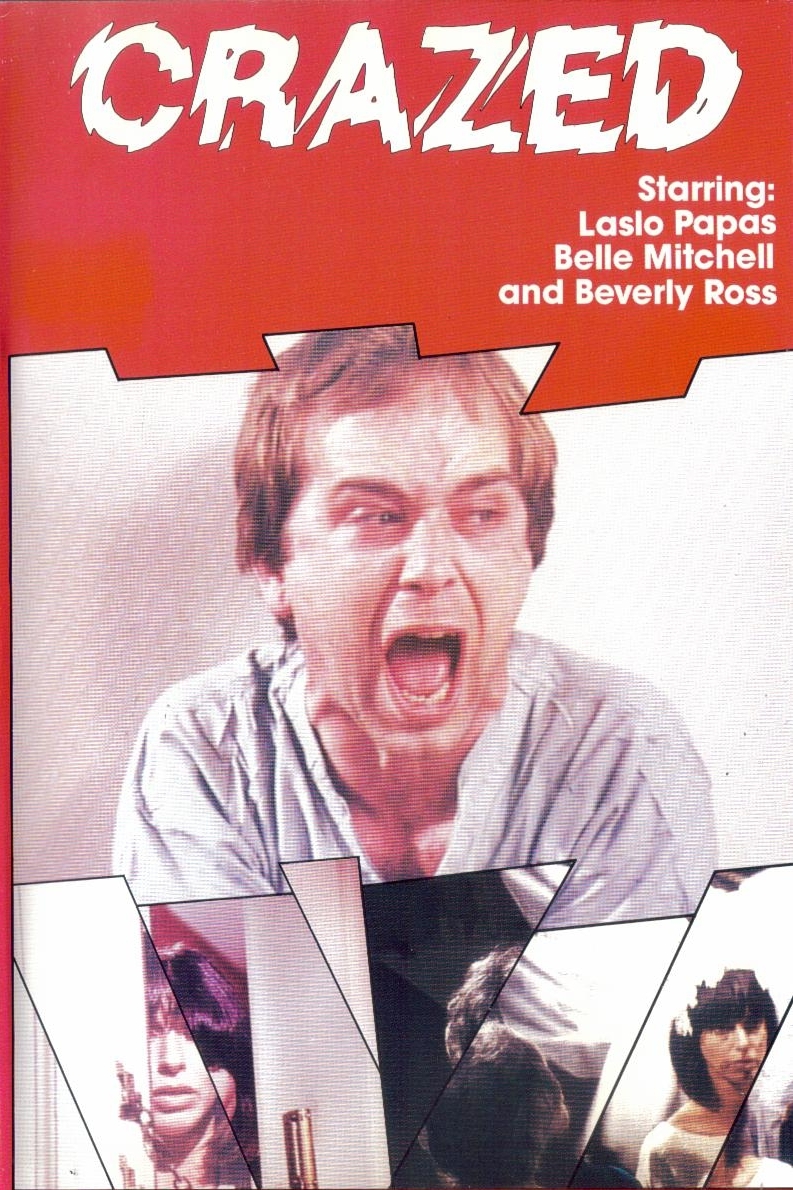
"Slipping Into Darkness", aka "Crazed" (1978)


It's impossible to overstate the impact of Alfred Hitchcock's "Psycho" on cinema, especially horror cinema. Some movies quote it with a visual cue, like when Susy Banyon pulls back the curtains surrounding the big bed of Helena Markos and sees only the imprint her body made there, or Stacy Nelkin distracting the motel manager while Tom Atkins gets a good look at the guest ledger of the Rose of Shannon Motel in Santa Mira, California. Other films, such as "Dressed To Kill", "Silent Scream", "The Unseen", William Castle's "Homicidal", and "Three On A Meathook", borrow so liberally from the story that it's a wonder nobody got sued. Add to that list a very strong low budget film I missed out on until recently, "Slipping Into Darkness", a movie that also appeared on VHS as "Bloodshed" and "Crazed". Although IMDB dates it as 1978, I'm guessing this refers to its 1978 theatrical release as "Slipping Into Darkness", because the movie actually looks like it was filmed around 1975 or 76. Part art house, part grindhouse, it's one of those types of movies that makes you feel like you need to bathe afterwards.


Although it does owe a lot to "Psycho", "Slipping Into Darkness" adds a few creepy new twists to the tragic story, and while "Psycho" kept a big secret until the end, there's no real mystery here and the emphasis is on the emotional horrors that its two protagonists experience. It opens from the perspective of Karen (Beverly Ross), a brooding young woman who seems to have a decent life on a farm with her boyfriend Rodney (Tommy McFadden). Just in case we didn't understand she's got some issues, we meet her as she is delivering a heartfelt monologue to a farm animal in a barn stall. It's clear that although she's facing one of her sheep, in her heart she's talking to Rodney. "I just have to see if I can do it on my own, away from here." She has a dream that she wants to pursue, something that will take her away from the farm. Rodney arrives home and finds her suitcase on the porch, and joins her in the barn. She never faces him, but keeps looking at the sheep. "You're really going," he says, and she nods, her face anguished. After he walks away, she sobs "I love you, I love you." She can't say it to him, she can only say these things when she has a passive animal to listen. As Karen leaves in her car, she flashes back to a diabetic seizure she suffered, which she survived because Rodney intervened. He asks her "What if you're alone and this happens?" Karen answers "So, I'll croak."


The thing Karen needs to do is pursue a career in writing, so she's leaving her life with Rodney to take a college writing course. We see her looking at potential boarding houses for a room, all of them offered by bizarre individuals. One is a stuffy woman with so many rules, it's clear she will be a renter's worst nightmare. Another woman is a frustrated writer who admits she gave up serious work to write pornography ("Plunging Genitalia and Throbbing Clit were best sellers in certain circles, OK?" she tells Karen). A third landlord shows her a room without a shirt on and propositions her. Perhaps out of frustration, she settles on a room in a big old house owned by daffy Mrs. Brewer (veteran character actress Belle Mitchell, in her final role). Although she rambles on as if she's senile, Mrs. Brewer's leg braces keep her confined to the first floor, and she tells Karen she hasn't been upstairs in 20 years. Karen soon learns that she has another roommate: an introverted oddball named Grahame (Laszlo Papas). Apparently having lived with the old lady for quite some time, Grahame seems to be a surrogate son for Mrs. Brewer, although she orders him around and demands that he be at her beck and call whenever she pounds on the ceiling with her broom handle. As soon as Karen agrees to take the room and starts to move in, the film reveals that Grahame is a voyeur who has rigged the upstairs so that he can spy on any other tenants of the house through peepholes in the wall and a two-way bathroom mirror.


As Karen settles into this new routine that she has started, Grahame watches her in her most intimate moments and begins to become more and more obsessed with her, but his attempts to befriend her are awkward and unwanted. Even when he offers to help her paint her room, Grahame makes Karen uncomfortable by airing some of his paranoid conspiracy theories. Rodney arrives and breaks up Grahame's attempt to get to know Karen, and he returns to his secret passage behind Karen's wall to watch them have sex.  In a brilliantly conceived sequence, Karen prepares for her first day of classes as Grahame watches from behind the mirror in her bathroom. She gives herself an affirmation in the medicine chest mirror: "You can do anything you goddamn want to." Suddenly she turns to the side mirror, the one Grahame happens to be standing behind, points at it accusingly and she says "You hear? You better hear. And you better goddamn well pay attention!" She doesn't know he's standing there, of course, but it's a strange reprise of her first scene in the movie, where she was talking to a sheep as a substitute for who she really wanted to talk to, Rodney. In this scene, she thinks she's talking to herself and she's really talking to Grahame.

The symbolism of the mirror illustrates that they are reflections of each other. Both Karen and Grahame are people who have lost their way in life, or at least that is how they feel. Karen could have continued her life on the farm with Rodney, whom she loves, but she needs to feel as if she can be secure without him. She also can't express herself when it comes to her emotions; she can't tell Rodney she loves him, even though she does. Grahame can't reach out, either, having experienced the pain of rejection and abandonment so many times that he has retreated into a fantasy life, turning to voyeurism to attain some form of intimacy with another human being.

The scene where Grahame watches Karen have sex with Rodney is the first glimpse we get of the film's use of disconnected images and audio to represent Grahame's inner thought life. Whenever he faces these moments of unhappiness and crisis, we see Grahame's past pieced together in a series of random flashbacks, and this ability to take us inside Grahame's head is the most disturbing aspect of "Slipping Into Darkness". The scenes are fragmented and non-linear, jumping around to different disappointments and humiliations in his life. As a young boy, we first see his parents abandon him at an institution, saying they're "returning" him because he is non-communicative and they suspect he is brain damaged--this suggests Grahame was adopted and these are not his birth parents. The mother in particular seems to be the one rejecting him, and it's her voice who keeps returning during the film's hallucinatory flashback montages, saying her son is "retarded". Grahame's father sits sideways, not meeting anybody's eyes, seemingly unable to assert himself and looking guilty. The mother cruelly kisses the young Grahame through a chain link fence before they leave him forever, saying they'll be back. We assume they never returned when later, Grahame's visions of himself in the military intersect with his childhood recollections; either upon discharge or on leave, he attempts to visit his family and is driven off the rural property by two strangers that appear on the porch of his former home, one holding a shotgun. They refuse to speak to Grahame, so he turns and leaves, presuming his family has either moved away or no longer wants contact with him. We see him hitchhiking back to the army base, his attempt to reconnect with the parents who abandoned him having been met with hostility, leading him to understand he is alone in the world. As he wanders the base, he hears an eerie, beckoning voice whispering his name. Interestingly, he is glimpsed through a chain link fence here, too.

Additionally, we are shown humiliating vignettes that illustrate Grahame's loneliness for a woman. When he and his army buddies patronize a prostitute, she mocks him during the sex act and also in front of the others afterwards. In the present day, we see him visiting a massage parlor and paying for female contact, the awkward sex act intercut with visions in Grahame's head of a fanatical preacher praying in an aggressive way over young Grahame. Finally, during the film's crucial turning point, we see splintered fragments of scenes that provide the key to Grahame's intimacy issues: at a very young age, he is abused sexually by a group of older boys, and after the abuse is discovered by Grahame's adoptive father, the man humiliates Grahame and then also sexually abuses him.


These painful segments build a very sympathetic and realistic backdrop for Grahame's character, as do the moments where we see Grahame being kind to his elderly companions. Not only is he patient with the daffy Mrs. Brewer, Grahame also works as a night clerk in a fleabag hotel that seems to be mainly populated by old folks with nowhere else to go. His unhealthy obsession with Karen begins to get the better of him though, and the situation takes a sudden turn for the worst, beginning Grahame's descent into madness.

Encouraged by his elderly companions to make a date with Karen, Grahame works up the nerve to ask her out only to have her reject him; in response, he loses control and forces himself into her room and starts kissing her violently. When it becomes clear Karen is not enjoying it, Grahame seems to snap out of it and leaves, aware that he has now permanently damaged his relationship with her by attacking her. Before he leaves, he says "I love you, I love you." He goes back to his room distraught and screams at his reflection in the mirror, and this is where we see the flashback that reveals Grahame's molestation. He smashes a mirror while screaming over and over at his fragmented reflection, "Stupid, stupid!" Karen hears it in the next room and is shocked at the violent side the normally quite Grahame has revealed to her.

Karen is confused and upset afterwards; she tries to tell Mrs. Brewer what happened, but the old lady won't listen to her. She takes a phone call from Rodney and makes plans to meet him on the weekend, then she goes upstairs to take a bath. Grahame is watching her as usual when Mrs. Brewer bangs on the ceiling to summon him. While Grahame is distracted, Rodney's prediction comes true when Karen suffers a diabetic seizure in the bathtub, and with nobody there to intervene, she drowns. When Grahame returns and discovers her body, he drags it into his bedroom in an attempt to revive her, but is suddenly overcome by the reality of having her nude body to himself. He begins to kiss her corpse tenderly, and decides to keep the body with him in his bed.

The shock of Karen's story ending so abruptly in the film is compounded by the desperation that we know Grahame feels at discovering the object of his romantic obsession dead, and even though it's horrifying that he seems to be lapsing into necrophilia, it's even more disturbing to know that he has finally found a small bit of happiness in this sick situation, her corpse a prop for his fantasy life that was raging all that time he watched her in secret. But the clock is ticking on Grahame's newfound "relationship"; soon Rodney comes looking for Karen, and so does Chuck, and Mrs. Brewer won't stop trying to find what's causing that foul smell in the house. Chuck comes back to the house on his own and discovers Grahame in Karen's room, looking through her things. When he begins to question Grahame and threatens to go to the police, Grahame tells him Karen is in his bedroom; they're a couple now, and she doesn't want Rodney to know. When Chuck goes in and discovers Karen's corpse, Grahame stabs him to death in a horrifying murder scene that isn't excessively bloody, but disturbingly realistic.

Stashing Chuck's body in the bathtub, Grahame has now damned himself completely, having committed a murder in order to keep his ghoulish secret, but it's only a matter of time before Mrs. Brewer starts to get suspicious. While she's alone in the house, she manages to get upstairs to Grahame's room and investigates; in a fantastic sequence, we see her find a strange prayer closet in his bedroom, which she returns to twice before finally pulling a rope that causes Karen's suspended body to fall out of the attic. Grahame has now dressed the body in a wedding gown, revealing he considers dead Karen his bride. Although she tries to put on an act, Mrs. Brewer is unable to hide the fact that she discovered the body when Grahame returns, and in a very creepy segment he realizes he will have to murder this woman, the only constant relationship in his life and the only one he could consider any kind of parent. He strangles her to death and then starts to have conversations with her body as if she's still alive, hearing her voice in his head in response.

Grahame desires nothing more than to be left alone in his fantasy world with his growing collection of corpses, but the world won't be put off for long. Mrs. Brewer's equally obnoxious friend Mrs. Dobson comes calling as Grahame is making preparations to board up the house to keep intruders out, and she discovers the bodies. Grahame corners her in a bathroom and breaks down the door to murder her, but suddenly Rodney appears behind him and restrains him. The illusion now shattered, Grahame collapses and seems to snap back to reality momentarily, "Oh god, I loved her!" he shouts. Grahame's sanity now completely broken, the last images of him in the film are terrifyingly bleak: he is glimpsed through the chain link fence of a mental hospital exactly like when his parents abandoned him in an institution as a child. Secretly, Grahame scoops something up off the sidewalk before his accompanying nurse leads him gently along. Back in his cell, he opens his clenched hand to reveal an insect he captured and concealed to take back to his cell, presumably so desperate for companionship. To his horror, he realizes that in smuggling the insect inside, he has killed it. Grahame hears that eerie whispering of his name again, his face twisting into an insane grimace of anguish.


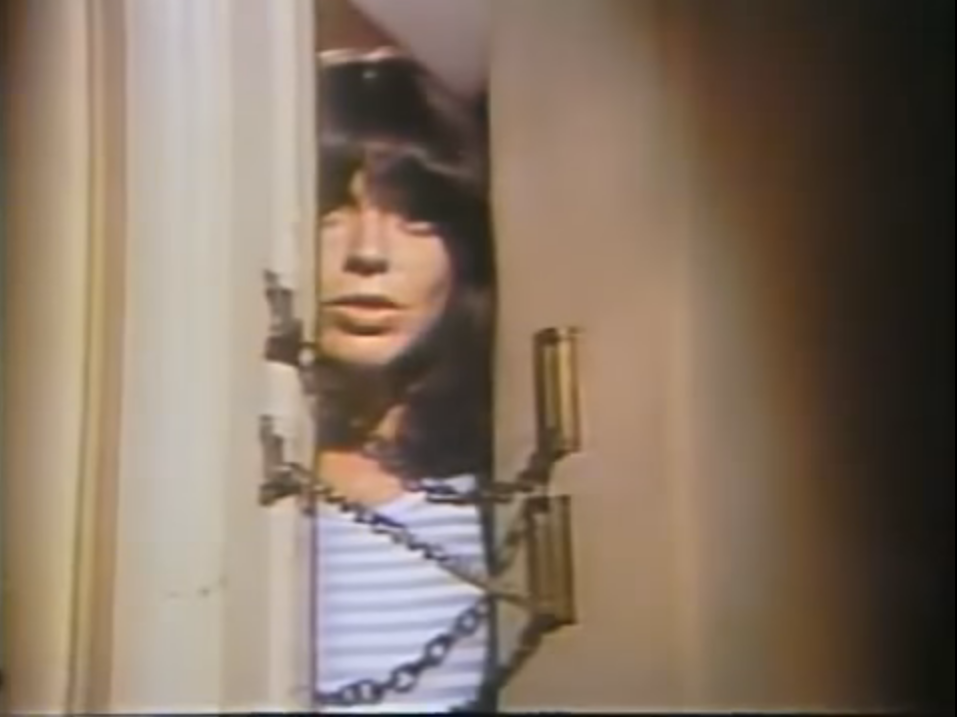
The central performance by Laszlo Papas is extraordinary. For a character who is first presented as a threat, a mumbling creep who invades peoples privacy by spying on them in the bathroom, we end up disturbingly familiar and sympathetic with him. We first glimpse him when Karen mistakenly opens the door to his room, which he secures with three chains (in the early stages, the script was titled "The Paranoiac", which would also explain Grahame's illogical ramblings about mind control). Both Karen and Grahame speak in a hushed, hesitant cadence, another thing that ties their characters together, and their delivery is very unaffected and real.

The comparison to "Psycho" is unavoidable, and the movie seems to embrace this rather than ignore the elephant in the room. Writer/director Richard Cassidy (a first time director whose only other credit as such is a 1990 documentary on the Dead Sea Scrolls) endows the film with a lot of sly references and in-jokes. For instance, he probably didn't have to make Grahame a hotel clerk, or provide shots of Mrs. Brewer's big old house with the upstairs windows lit. There are numerous other references too, like the sudden death of the heroine long before the film is over (and while she's bathing, even), the peeping from behind walls, the creative use of mirrors, the old woman's corpse that the young man talks to, a crucial scene that involves a hanging lamp that ends up swinging, and the ending of the film showing the young man in a mental hospital.

There are a few eccentric performances in the film to counter the heaviness of the material. Belle Mitchell plays her scenes as comedy, although her character is an interesting counterpart to Grahame's. She is an elderly woman, and she tells Karen she's had leg braces for twenty years, limiting her movement. She is trapped in her own house, so to speak, and her shrinking world has gotten even smaller at the time of the story, as it's revealed her husband has recently passed away. It would be easy to call her senile the way she talks to Grahame and the others, but perhaps this is just the way being isolated and lonely has changed her, it has turned her into a shrewish busybody who makes constant demands on the limited people in her immediate vicinity. A haunting scene occurs when Grahame is on duty at the hotel where he works, and we see numerous elderly people shuffling around silently, staring at a television, barely communicating, and Grahame sits in close proximity to them, underscoring his similarity to them. Mrs. Brewer's elderly friend Mrs. Dobson, played by Helen Rogler, is also played as a caricature and figures strongly in the film's climax; in comparing the film to "Psycho", she's the Vera Miles character who discovers the bodies in the house and is attacked. Rodney is the Sam Loomis character, our deceased female heroine's surviving boyfriend, rushing in at the last minute to grab Grahame from behind and restrain him before he can attack Mrs. Dodson with a hammer. Both Rodney and Chuck are played as assertive alpha male types, the kind of man Grahame can never become, adding to his alienation. Also keep a lookout for a brief but memorable scene involving Karen's intense creative writing professor, who delivers a berserk monologue about becoming a writer that sounds like something from "Full Metal Jacket".

The score is effective, with two distinct personalities throughout the film. One is an ominous horror approach with low, churning strings that don't exactly mimic Bernard Hermann's score for "Psycho", but don't stray too far from the game plan, either. Early in the film, Karen sets out on her doomed journey with the strings in frantic spooky mode, driving away from her trapped existence and directly into her own destruction just like Marion Crane. Another recurring theme figures most prominently over the end of the film, a melancholy piece with harp and flute that represents the tragedy of Grahame's life. The suspense and shock themes often sound a little campy, but there is a strong sense of humor in certain parts of the film already.


This movie probably disappointed people who rented it on VHS expecting a lot of gore, aside from the knife attack on Chuck that I mentioned. Even the corpses don't really look like corpses; Karen's body is supposed to have been decomposing for at least a week, and Mrs. Brewer complains vehemently about the rotten smell in the house, yet when we see the body it doesn't look like she's been dead for more than a few hours. The opportunity to present the horror of sleeping with a corpse could have been more disturbing had the director chosen to go with a more gruesome makeup job on Beverly Ross. Maybe he was worried about the rating it would get the movie, or maybe he just wanted to keep the horror psychological.

This was definitely a good thing, as the film is able to easily communicate where its characters are coming from, even without a lot of dialogue. That final image of Grahame is haunting, a freeze frame that turns it into a lingering silent scream of despair, and this is the essence of the film's horror. Being isolated and alone is a terrifying concept for many people, whether it is a literal separation from society or simply the inability to reach out to others and communicate. Richard Cassidy brings both of these perspectives to his film and more; it's a shame that this film seems to be obscure, it deserves a much wider audience.


Sunday, January 3, 2016

"Don't Hang Up," aka "Don't Open the Door!" (1974)

Low budget auteur S.F. Brownrigg only made a handful of films over the course of just a few years, four horror films and a sex comedy. His most familiar movie is 1973's "Don't Look In The Basement", having received a wide release in theaters and drive-ins across America, as well as appearing frequently on TV. Filmed around the same time with several of the same actors is a lesser-known film he originally titled "Don't Hang Up", which premiered in Paris, Texas in May 1974. It later got an official theatrical release in 1979 as "Don't Open the Door!", which is the title it appeared most frequently with on home video and on television.

From the film's premiere in Paris, Texas, May 3, 1974
It's true that Brownrigg's films were cheap, and often cheap looking, but that didn't stand in the way of his creativity. "Don't Open The Door" has that same ultra low budget look and feel of its three other siblings, but the level of craftsmanship on hand is obvious from the very beginning, and Brownrigg makes full use of the elements at his disposal to tell his lurid story. The opening shot is of Annabelle Weenick (Dr. Masters in "Don't Look In The Basement") walking down the hallway of a train car while we hear audio effects of a moving train. Then she enters a room to have a conversation with Gene Ross (one of the only actors to appear in all four of Brownrigg's horror films) and we can tell by the windows that they're not on a moving train. So, we think, a train must be passing nearby. Then after they have their menacing confrontation, which ends with Gene Ross smacking her down, Weenick leaves and we see they really were in a train car after all, one that's been converted into a home. Ross goes to a cabinet and fiddles with a cassette player inside a cabinet--he's been sitting in there listening to a tape recording of what it sounds like to be on a moving train. Ross never really breaks the fourth wall, but he seems to be talking to the audience when he says "All aboard." It's a brilliantly conceived scene, and it exemplifies how Brownrigg used simple techniques of editing, sound design and camera work to disorient and unnerve the audience. Even though nothing seemingly significant has happened, the strange undercurrents in the scene make it intriguing enough to pull you into the story. The actors carry the scene well, too--Brownrigg's characters are like people you may known in real life, but they seem to be caught in this weird place between dreaming and waking. There's something larger than life about them, something not quite realistic but not too far from the truth, either.


The opening titles are a fantastic sequence of surreal, strange looking dolls on a black background, accompanied by a very well done 70s-era score, with ominous elevator-music flutes, a dominating bass guitar, and a harpsichord that would be almost Laurie Partridge if it wasn't so spooky sounding. The score goes back and forth between these intricate, jazzy arrangements to stark, percussive stingers. In one of the film's creepiest moments, a sleeping woman is approached by an assailant with a knife occupying the camera's point of view, while on the sound track percussion bubbles with an erratic dual heartbeat.

The use of point of view shots is common in Brownrigg's films, and so are closeup shots that make ordinary gestures seem ominous. Our heroine in "Don't Open the Door" gets a series of sadistic phone calls from an anonymous, whispering man, and one shot is dominated by the spiral phone cord while she is slightly out of focus behind it, the shot resolving itself as she hangs up and brings the receiver toward the camera, close up and in focus. The use of shadows is also tremendous in this film. The villain makes his phone calls from a secret place in the house, hiding in what seems to be a crawlspace or passage between the walls, with his face lit only dimly. Amanda is shot mainly in bright light at the beginning of the film, although toward the climax she, too, is filmed in shadow and darkness.

The house used in the film features this unique tower with multicolored windows. Susan Bracken's character in the film, Amanda, calls it 'the house of seasons'.
The plot allows for a number of familiar but effective scare situations: you're in a big old house alone, you're hearing noises. You're asleep and you awaken with the feeling that someone was in the room with you just seconds before. You're getting threatening phone calls that suggest you're being watched. Susan Bracken makes an unusual heroine for a film like this too, because although she's in a very precarious position, she doesn't show much fear. Bracken, daughter of prolific character actor Eddie Bracken, didn't appear in many other projects. Her delivery reminds me a lot of Melody Patterson in "Blood and Lace": she's extremely headstrong and outspoken, and even when she gets the first creepy phone call, she isn't even compelled to hang up once she realizes it's someone toying with her. She's almost daring the world to do its worst, and boy does it ever.

Bracken plays a character named Amanda Post, who has come to the small Texas town of her youth after she gets a mysterious answering machine message (from Weenick, in the opening scene) warning her that her grandmother is in poor health and needs her intervention. Amanda returns to her grandmother's big old house in Allerton to find her in the care of a shady doctor employed by Stemple (Gene Ross), a local judge who describes himself as the comatose old lady's "attorney". But the wackiest of all is Claude Kearn (Larry O'Dwyer), the curator of a local antique "museum". The film only makes a rudimentary attempt at concealing the fact that Claude is its chief villain; after Amanda makes it clear to everyone that she intends to take care of her grandmother (and presumably claim the house upon her death), she starts getting the threatening, sexually charged phone calls, and the camera depicts Kearn in shadows and closeups, not revealing him immediately but not exactly concerned with concealing his identity either, due to the fact that it clearly shows his distinctive eyeglasses. The obsessed Kearn, we assume, is also Amanda's mother's killer, but we don't understand exactly what his game is until closer to the end. Stemple also seems as corrupt as they come, especially after his violent confrontation with Weenick at the beginning. Both she and Claude Kearn allude to the fact that they know what kind of shady doings Stemple has been up to, but Stemple also seems to be hiding the truth about who killed Amanda's mother.

The real sicko though is Kearn, and the audience wonders why Amanda doesn't identify him as the killer on her own. This film is Larry O'Dwyer's only IMDB credit, but like most of Brownrigg's actors, he was a prominent local stage actor. O'Dwyer strikes a perfect balance between neurotic, angst-ridden freak and menacing, whispering psychopath, his longish hair and wire-rimmed glasses suggesting a demented Ben Franklin, his twitchy face often breaking out into a toothy, unsettling grin. At one point Amanda visits Claude's creepy museum, which has been housing a lot of her grandmother's antiques. Kearn makes it clear he is obsessive about the collection, panicked that she might take the items away. Then he takes her to an upstairs room to reveal to her that he's dressed a mannequin to resemble Amanda's mother, which makes Amanda furious. She leaves angry, demanding the return of all her grandmother's antiques. Instead of calling the state police though, she somehow doesn't understand the implications of Kearn revealing this secret part of himself to her.

But Kearn isn't interested in actually killing Amanda, not even when he drugs her and touches her intimately while she's unconscious. What he really wants is to manipulate and toy with her, to lure her into a game that her mother apparently refused to play. At first Amanda handles her strange phone caller with indifference, but eventually he gets into her head when she starts to realize that she's talking to her mother's killer. In an excruciating scene, he threatens to kill her grandmother unless Amanda engages in phone sex with him. Afterwards, before hanging up with her, he commands her to go to sleep and forbids her to leave the house or use the phone. At this point she doesn't realize he's in the house with her, watching her, but she obeys him anyway.

Amanda's potential knight in shining armor is her ex lover Nick, a physician who follows her to offer support and medical care for Amanda's ailing grandmother. He's interested in winning her back, but we start to feel Amanda's frustration and alienation when she calls him at the hospital after the phone sex incident and he won't listen to a thing she says, not even when she tries to tell him she's in danger. Amanda gradually loses her ability to tell what's real and what isn't. By the time the finale is set in motion, Amanda has suspected everyone of being her strange phone caller--even Annabelle Weenick!--despite the fact that only one person in the cast has shown her a fucking mannequin dressed like her dead mother. As if that clue wasn't enough, Amanda also is tricked into thinking Nick is home with her when she sees a sleeping form in a bed. She later returns to the room to find that what she assumed was Nick is actually a mannequin. Hmmmmm... Her inability to see the truth is what proves to be her own undoing--she ends the film as deranged as Kearn, finally claimed by her tragic family history.

In the end, Brownrigg's story (written by Frank Schaefer and Kerry Newcomb) finds its greatest horror not in the staging of murders, but in the disintegration of Amanda's stability, much like 1973's "Let's Scare Jessica To Death". All four of Brownrigg's horror films dealt with insanity, with no supernatural elements whatsoever, although "Don't Open the Door!" and "Keep My Grave Open" both have a strong phantasmagorical quality to them with extended sequences where Brownrigg indulgently lets his camera linger on certain details and characters, like the scene where Amanda is drugged. Brownrigg doesn't actually let Kearn's face be shown in this scene, even though we know it's him. Instead, we see his hands in closeup on Amanda's body while echoing dialogue repeats on the soundtrack. There is also a fantastic sequence near the beginning of the film where Amanda explores the old house, the camera following her up staircase after staircase until she is standing in the unique tower at the top of the house, surrounded by different colored windows.

These art house moments may have been considered a liability in the long run though, when it was time to market Brownrigg's films to a mass audience. "Don't Look In The Basement" remains Brownrigg's best-known movie, and it's no coincidence that out of all his films, that's the one that moves at a faster pace (with plenty of blood). Although "Don't Open the Door!" is as good of a story as "Don't Look In The Basement", it is nowhere near as widely seen, probably due to its low body count and the unceremonious way that it presents its murders (the chilling flashback death of Amanada's mother at the beginning notwithstanding). It's interesting though that Brownrigg made the choices to be more realistic with the deaths in this film. The message seems to be that even though another person can take your life, another person taking your sanity is even more frightening.


Sunday, August 2, 2015

The Unseen (1980)


"The Unseen" is one of those movies I missed on its first few tours of duty; I wasn't interested in it enough to beg my parents to take me to see it at the drive-in, and it didn't run long enough on HBO for me to get the chance to stay up past my bedtime and watch it. Little did I know, "The Unseen" is one of those numerous horror movies where someone has a dreadful family member and locks them away in some remote portion of a large, rambling house.

"Why yes, we've got the nicest old house you've ever unseen!"
Usually when our story joins these sordid lives, it is at the point where the crazy family member has decided to take up a career in homicide. In the case of "The Unseen", the 'monster' is an inbred Downs syndrome boy who is the result of an incestuous relationship between two siblings in an already crazy family. The character ends up being nothing more than a Lenny type who doesn't know any better, but the filmmakers see him as a cross between Frankenstein's creature and Sloth from "The Goonies". "Junior" is kept in the cellar of his family home by his parents, Ernest Keller (Sydney Lassick) and his sister Virginia (Lelia Goldoni). Ernest runs a "motel", and he keeps the mummified corpse of his father locked in there and has conversations with it. In case you're the last person on the planet to have not seen "Psycho", that part might seem really original and creepy to you. But maybe not.

I refuse to speak of disgusting things because they disgust me!

Into this cesspool of insanity comes pretty TV news reporter Jennifer Fast (Barbara Bach), who is out doing a very important news piece on an ethnic festival full of people of Danish heritage. She brings along a posse made up of her sister, Karen (Karen Lamm), and Karen's 'traveling companion', Vicki (Lois Young). Karen is Jennifer's camera operator, and I had no idea what Vicki had to do with any of it until one moment in the film that seemed to suggest that Vicki and Karen were a couple. Forced to drive out of town to find lodging for the night, they stumble upon Ernest's 'hotel', and when they find out it's just a museum, Ernest offers to let them stay the night in his own house. The girls obviously did not read the script, because they agree, and before they even realize it, they're Unseen-bait. The first to go is the luckless Vicki, who begs off of driving back to the parade because she feels ill and wants to take a hot bath. After Ernest spies on her getting naked in the tub, she is attacked by The Unseen, who remains unseen through the entire ordeal. Vicki is frightened out of her bed, hurled around the room, and then dragged feet-first into a heating vent from which the unseen emerged. On the way down into the vent, the average-sized grate falls on her head and apparently kills her. We don't really understand how she could die from a heating vent falling over onto its side, but that's nothing compared to the fact that the villain is later revealed to be a 300 pound man who somehow climbed through a heating duct up to the second floor of the house and emerged from a shoebox-sized grate in the floor. In "The Unseen", you just kind of go with it.
Vicki's nether regions are totally seen...

....totally seen.

If she was chilly she could have just put on a sweater, geez, who climbs into the heating vent??

Back in TV-reporting land, Jennifer's businesslike demeanor is visibly shaken when her estranged lover shows up unannounced looking for a reconciliation. Having traced her to the Danish folk festival, Tony (Douglas Barr) talks Jennifer into a long walk so they can sort out their differences. Karen goes back to the house to "touch base" with Vicki (heh heh) and fails to notice that her head is now sticking out of the heating vent on the floor. She wanders into the clutches of The Unseen when she happens to drop a bowl of fruit right over the heating vent he's hiding in. Yes, the old heating vent trick happens again, which leads me to believe that this particular big old house must have been built with duct work that was intended to be an alternate living space. This time, his victim might have lived if she had only avoided wearing a long, dangling scarf, which leads to her getting a facelift courtesy of The Unseen.
"Look, I'm trying to find my motivation here but I'm starting to realize my part of the script is padding. Don't you think?"
"Duh."

Karen once asked a fortune teller how she'd die, and she replied "Face first. With fruit."

Virginia, who speaks few words but emotes quite emphatically, is horrified at the murders, even though she seemed to know that this is where it was all heading (she, alas, DID read the script). But Ernest is a sissyboy psycho, and apparently not only does he enjoy beating up on Virginia and The Unseen, but he also gets off on the fact that these pretty young girls are being iced in his own home. A guy's gotta get his jollies somewhere.

"I just cleaned that carpet!!!"
So the finale of the film finally arrives: Jennifer, fresh from her heated debate with Tony, arrives back at the house in time for a thunderstorm, the kind that looks suspiciously like a garden hose being sprayed against the window. Finding no trace of her companions, she ignores all sorts of warning bells that should be going off in her head and follows Ernest's voice down into the basement, where he tricks her into holding a large piece of duct while he runs upstairs and bolts the door, locking her in with The Unseen. We finally get a look at him after he scares the shit out of Jennifer and makes her go all grabby on the house's electrical fuse box, causing a flashing light show in the basement. She also steps on a nail (or something), and here's where things start to get a little hard to follow. At some point, one of these injuries (either stepping on the nail or touching the haywire fuse box) causes Jennifer to lose control of her legs, and she can't even bring herself to stand up through the rest of the film's climax. The Unseen finally gets some screen time when he tries to make her be his little baby friend. When he doesn't kill her, Ernest comes back down into the basement and attempts to strangle her with a belt. Virginia interferes, but Ernest gives her the beat-down while Jennifer drags herself away with her arms, darn those pesky legs that won't work! When Ernest punches Virginia in the face, Junior attacks him. Ernest fights back, though, and whacks The Unseen in the side of the head with a board, puncturing his temple with a long nail. Virginia regains consciousness long enough to see it happen, and she freaks.


"What are you crybabying about, Barbara? Look at my costume!"

Meanwhile, Jennifer has managed to drag herself, useless legs and all, out into the yard, where she hides in a chicken coop. She regains control of her legs long enough to stand and grab an axe, which Ernest wrests away from her. Then she's back to dragging herself, this time out into the mud, where she inches her way along the ground like a Jennifer-sized inchworm. Tony shows up in the nick of time, but alas...his leg injury, the same one that ended his promising football career, stops him from rushing to her aid. Just when Ernest is about to bury the axe in Jennifer's head, Virginia appears on the back porch and blows him away with a shotgun. She's a damn good shot, too.


"The Unseen" is quite lame, quite tame, and nearly bloodless. Without a full-frontal nude scene during Vicki's bath, it would probably never have gotten an R rating. It's hard to get past the similarities to other, better movies. It's got more than a few things in common with "Silent Scream", which came out around the same time but was at least a little more atmospheric, if not fantastic. It also had a more interesting cast. The script has some interesting things roiling beneath the surface, like the hint that Vicki and Karen are a couple, and some politics about Jennifer's unplanned pregnancy, but that doesn't make up for the fact that the story is contrived, silly, and not very scary. The girls are pretty pretty, and Sydney Lassick is excellent as the kookoo Ernest. It might have helped if Barbara Bach's character had been a little more spunky when she needed to be. She doesn't lift a finger to defend herself when she's threatened, and she can't even friggin stand up. A big liability is that we're supposed to be afraid of Junior, played by Stephen Furst, but it's hard to get past the fact that they're asking us to buy a handicapped man as a monster. I kept wondering why Barbara Bach didn't recognize that Junior was a victim. The script wasn't intelligent enough to have her show Junior a little sympathy and maybe, oh I dunno, not be afraid of him after all? If he'd refused to kill her because she didn't turn into a screamer when she saw him, they still could have ended the movie the same way and it would have been much more compelling. Bottom line: "The Unseen" won't make your head hurt, but it ain't gonna scare you so bad you lose control of your legs, either.