Showing posts with label low budget classic. Show all posts

Monday, August 15, 2011

Night of the Living Dead (1968): It Keeps Coming Back!


It seems all I've been posting about here lately has been zombie pictures, so I guess it's fitting that tonight I rewatched the one, the only, the original, "Night of the Living Dead".  I remember seeing it twice as a child; once was on television right when "Dawn of the Dead" was about to premiere in theaters, which would make me 8 years old at the time.  The other time was when my mom took me and a friend to see an outdoor movie in a local park, and it turned out to be this one.  I'm not sure which screening came first, but I do remember being transfixed by the film each time, specifically by how explicit the violence was, and the overall downbeat tone. 


Even though most of what happens in the movie occurs offscreen and we only see the aftermath, there was an aggressive edge to it.  You get the impression that Romero would have shown you everything if he'd been able to make it look effective. But "Night of the Living Dead" combined its early gore effects with a certain level of pseudo realism that was missing from the campy, color grossout films being made by Herschell Gordon Lewis, and an unflinching attitude that went beyond anything that was typical at the time. Ben, the hero, bashes in the heads of several ghouls in the beginning, using a tire iron. At one point, he embeds the sharp end in the skull of a zombie, and it falls back to the carpet after he pulls the tire iron back out.  Even though the penetration has occurred off screen, the illusion is very effective. It still looks upsetting today, as does the grossout scene where a group of zombies fight with each other on-screen over a pile of intestines.


Another thing I love is the way Romero was able to make the murder of Helen Cooper so compellingly surreal and brutal at the same time.  Her death is the one zombie attack in the film that never fails to freak me out, the nightmarish pinnacle of the film. You know the scene, it's when she goes back into the basement as a last resort and the little girl zombie kills her with a handy cement trowel. When I was a kid I used to always wonder why Helen never tried to defend herself with her hands, but as an adult it becomes a little more clear to me that she's in the moment; she's just seen her husband shot dead in front of her, scores of zombies are beginning to burst through the barricades, and she has now discovered her young daughter is not only dead, she's devouring what's left of her husband.  When the little girl advances on her, Helen just kind of collapses in shock and lays there, letting her own little girl slowly hack open her ribcage, an agonizing death, all the while emitting those unearthly death screams as it happens. It's a moment of true horror, a subversion of the family unit in a way that wasn't often seen with such chilling detail.  It happens with Barbara, too; of all the zombies that have inexplicably come to this rural farmhouse, the one that confronts Barbara is her own brother, Johnny, who drags her off into a crowd of ghouls to be devoured.  Barbara has remained disassociated throughout almost the entire film until that very moment; seeing Johnny seems to bring her out of her shock long enough to realize she's about to be killed, and she screams for Ben to help her, too late.  I always shudder at the way you can see her face for a split second right before they pull her all the way down and, presumably, rip her apart while she's still alive. These weren't strangers committing acts of random violence, these were the family members of their victims. Romero & Russo weren't only interested in showing a brutal murder, it was also a total mindfuck.

The cynical, downbeat quality of "Night of the Living Dead" breaks some serious ground for horror, as other filmmakers began to emulate such things as the explicit use of gore, the zombie subject matter itself, or the unapologetically gruesome tone.

Contrary to popular discourse, the movie does indeed offer an explanation of why the dead are returning to life. The talking heads we see on television reporting the phenomenon have made a link to a recently crashed space probe that carried high levels of "mysterious radiation". The film's 1978 sequel, "Dawn of the Dead", completely sidestepped this explanation, and this time Romero stated in interviews that there was no known reason for the reanimation of the dead, and that the radiation scenario from the original was not intended to be the definitive explanation. But Romero had also started referring to the work as a 'trilogy', and that it had always been intended as a trilogy, which is something he had never mentioned in print after the original film debuted...prior to his 1977 interview in Film Comment, he'd never even alluded to a potential sequel. In fact, two years after making the 'trilogy' comment, he told Cinema Spectrum that when he was making "Night", he never knew he would ever make another film like it. It seems odd that in a script like "Night of the Living Dead", the crash of a radioactive space probe and the subsequent emergence of zombies from that same area could have been intended as anything other than an explanation. Otherwise, what the hell was it, a strange coincidence?

Regardless of implicit intentions, the ending of "Night" closes on a scenario where the living now outnumber the living dead once more and are rounding them up to be thrown onto huge bonfires. The TV news reports that the level of the radiation is decreasing, and this is the ultimate tragedy of our small group of non-survivors: if they'd just managed to hold it together a little while longer, they'd have lived to see the end of the emergency.  Instead, they're all dead at the end.


The moment any movie's end credits begin is often the moment where people stop paying attention, but that's one of the most disturbing aspects of "Night of the Living Dead".  Hidden in plain sight during the end credit sequence is a series of horrifying still images of Ben's body being dragged away by possee members weilding meat hooks, to be thrown on a bonfire with other bodies and set ablaze.  Knowing that just moments before, he was the only survivor of the film, and a random act by an overly enthusiastic possee member leads to him being shot dead and viciously violated.  This wasn't done to him by zombies, but by ordinary, living human beings, with shotguns and meat hooks.  Now that's a scary concept.


Friday, April 1, 2011

"Don't Look In the Basement (1973)", aka "The Forgotten"


In terms of atmosphere, artfulness, and just flat out insanity, you can't do any better than this 70s freak-out best known as "Don't Look In the Basement". Authentic 70s doom through and through, this cheap little movie played drive-in theaters for years, first released in 1973 under its original title "The Forgotten". Another theatrical run came shortly after, when the film was picked up by Hallmark Releasing, the same distributor as the highly successful "Last House On The Left".  Despite sharing no connecting producers or director, Hallmark retitled the film "Don't Look In The Basement" and claimed it was "from the makers of Last House On The Left", and it played drive-ins for years after, often being retitled lurid things like "The Snake Pit", "Death Ward 13", and my personal favorite "Beyond Help". Its original title is usually blotted out by a cartoonish post-production title card, unfortunately breaking up the gorgeous sequence where star Rosie Holotik arrives at the spooky isolated location where the film takes place (which of course, in reality, is not quite so isolated as it appears in the film). Directed by independent Texan filmmaker S.F. Brownrigg and featuring a cast made up mostly of local Texas stage actors who were unknown to moviegoers (with a few notable exceptions), "Don't Look In the Basement" is one of only a handful of films Brownrigg made, and easily the most well-known.


"Hello, operator? I'm trying to figure out why my phone doesn't work. Operator? Operator?"

Brownrigg's specialty was creating a unique, foreboding environment in his movies; he endows this one with a claustrophobic tone, wringing as much atmosphere and drama as possible out of a limited series of rooms and hallways. "Don't Look In the Basement" imagines a large, secluded farmhouse as an experimental sanitorium for the insane, where the patients share a communal living arrangement with the small staff of doctors and nurses. Dr. Stephens runs the place under the theory that allowing each of the patients to enact his or her own unique fixation will enable them to become sane again. At the outset, it appears as if Dr. Stephens has been murdered, along with one of the nurses. A young nurse named Charlotte comes to the house and identifies herself as a new hire summoned by Dr. Stephens. She finds a woman named Dr. Masters in charge, who reluctantly allows her to stay due to the fact that she appears to be the only other person on the staff at this point. The living arrangement comes as culture shock to Charlotte, who learns there are no locks on any of the doors and no real privacy. There also seems to be no working phone, and the secluded nature of the location results in her total isolation from the outside world. The characters in the film cover just about any range of neuroses or stereotypical mental problem that the screenwriter could think of: a shell-shocked Vietnam vet, a daffy old woman, a childlike lobotomized hulk, an infantile and dangerous young man, a woman who suddenly goes from being docile to violent outbursts, a former judge who spouts legal gibberish while wielding an axe. The actors in the film are all diverse and interesting, and their performances are memorable and even likable, even though they are also beyond criticism; how can you fault an actor's abilities when the script requires them to act insane? Rosie Holotik is very pretty and vulnerable as Charlotte, although you may not have much sympathy for her after the tenth time someone tries to tell her something's wrong and she refuses to take it seriously.


Although it's fairly clear from the beginning that the inmates have taken over the asylum, the twist isn't the reason the film exists. If you're not paying close attention, the moment could come as a surprise to you, but much like his "Don't Hang Up",  Brownrigg doesn't conceal the truth from the viewer. The film's loose mystery hides in plain sight, such as a moment where Dr. Masters discovers her incriminating case file in the possession of another patient, and makes him hold the crumpled wad of paper while she sets it on fire and lets it burn in his hand. But part of the film's sick fascination is watching Charlotte come to the slow realization that her situation is more dire than she ever imagined, and this realization is about as slow as it gets. Charlotte is the kind of person who would probably ignore a flashing neon sign that said "DANGER!! RUN SCREAMING FROM THIS PLACE NOW!!!" It's the same frustrating tension that worked for "What Ever Happened to Baby Jane?", the type of situation that would have been immediately defused if the victim simply acted like a rational, sentient human being and started paying attention to the warning signs all around.


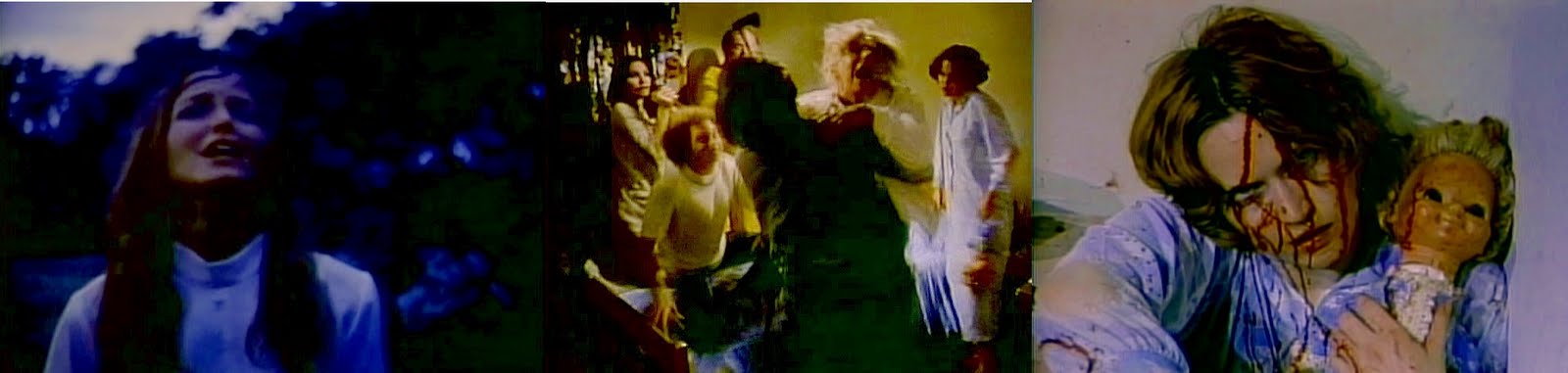
Brownrigg's low budget is overcome by the way the film draws you in. Although nonsensical at most times, Brownrigg makes the film unsettling through his visual approach as well as his story. Tight closeups that show faces at bizarre angles, carefully arranged shadows, bleak interiors lit by angular patterns of light, all of these are his trademarks. But even that won't make any director's film really grab you. There's a spoofy element to the story, too, with a lot of strange intentional humor. One of the inmates, a nymphomaniac named Allyson (Betty Chandler), corners a hapless telephone repairman in a closet and makes sexual advances on him that are somewhat terrifying. Camilla Carr (who also appears in "Scum of the Earth" and had the central role in Brownrigg's "Keep My Grave Open") plays Harriett, a woman treats her baby doll as if it's a real child. Her pathological delusion is actually compelling, until anybody dares take it from her, or shatter the illusion, when she turns violent and terrifying. Carr doesn't have many lines in the film, but she's one of the unforgettable characters. There's a great moment when Allyson says to her  "You poor thing, I feel so sorry for you. You really think that doll is a real baby!" Before the end of the film, Allyson will have descended into utter madness--after her tryst in the closet with the telephone man, she becomes convinced he is going to take her away from the asylum, but later she finds his bloody corpse and has a shattering breakdown, ultimately dragging it back to her bedroom and engaging in an act of necrophilia.


These connections between the patients are intriguing, and the script is complex without being convoluted. Each of the patients has a back story that becomes familiar throughout the course of the film, except for Jennifer (Harryette Warren), who has no dialogue and just keeps trying to either take drugs or stab people. Hugh Feagin plays the character The Sarge, forever damaged by a bad call that resulted in the deaths of his men. Feagin appeared in three of Brownrigg's films, also playing Susan Bracken's ex lover Nick in "Don't Hang Up!" and the out-of-nowhere killer in "Scum of the Earth" (aka "Poor White Trash Part II").  Rhea MacAdams is probably the only one in the film who truly seems like a non-actor; she is to Brownrigg as Edith Massey was to John Waters, a somewhat grotesque caricature with a bizarre delivery of only the most simple lines of dialogue. She keeps trying to tell Charlotte she's in trouble, and Masters cuts out her tongue for her trouble, somehow convincing the naive Charlotte the old lady did it to herself.

The major plot payoff comes when Charlotte finally understands what we've already been clued in to over and over again: that Dr. Masters is only another patient of Dr. Stephens, a dangerously disturbed woman who would mutilate or kill anybody who threatens to put an end to her own illusion that she's a doctor in charge of her co-patients. Masters is played by Anne MacAdams, later billed under her real name, Annabelle Weenick. Weenick was a very capable character actress who appeared in numerous screen productions, as well as television, and she is very convincing in all of her modes in the film: first an authoritative and in-control director of the facility, then a sad and compellingly disappointed failure, and finally a murderous madwoman. The scene where she explains her motivations at the end is a tremendous "big reveal" moment that has actual dramatic impact instead of just shock, a rarity in these types of low budget screamers. It reminds me of Betsy Palmer's big reveal moment in "Friday the 13th", only Weenick's character has a presence throughout the entire film here.

One of the film's many alternate titles--and strangely enough, one that Hallmark Releasing also used to retitle one of their other releases, the British thriller "The Computer Killers", aka "Horror Hospital".

But there are many other little mysteries that resolve themselves throughout the course of the film, too, visual and spoken clues that add up to things near the end of the movie, like the twist about Dr. Stephens. Although we never see it, we know he's still alive and trapped in the basement, perhaps injured and incapacitated but not dead, because Sam keeps trying to tell Charlotte this and she won't take him seriously. At one point, he brings her Dr. Stephens's watch, and she still doesn't get it. Finally she discovers Dr. Stephens at the end of the film, almost out of her mind with fright as she tries to escape the house, and she winds up beating him to death with one of Sam's toy boats. Yeah, it doesn't really seem like you could kill someone with a toy boat, but whatever. Just go with it, OK? Gene Ross appears in each of Brownrigg's four horror films, and he plays the axe-wielding Judge Cameron here. The Judge figures into another of the film's intriguing mini-revelations; as Charlotte tries to get the truth about Masters out of all the patients, Cameron tells Charlotte that she herself is also a patient, sent there to act out her fantasy of being a nurse. We sense this is most surely false, but Charlotte's reaction to it is one of terror, as her situation has completely undermined her own sense of security and reality.

Although it's fun to do so, movies like this weren't meant to be analyzed. They flashed across the giant drive-in screen while people sat in their cars, sometimes talking to one another. It also must be said that while "Don't Look in the Basement" is grisly, it's not exactly a gore flick. There's some bizarre violence, including the suggestion that one character gets her head cut off in a suitcase (don't ask), but you don't watch this for its blood and guts. Aside from a Grand Guignol finale where the inmates attack one of their own with axes and knives, the violence is all relatively tame. There's a certain pulpy artistry at work here that makes it work. The low budget and downbeat atmosphere make it very much of its time, and the only thing that's really missing is an ominous ballad; although the soundtrack is active and ever-present, there's never an actual song with lyrics. The DVD market is flooded with cheap public domain DVD transfers; as far as I know, there hasn't yet been a definitive home video treatment for this film. Even though the film actually benefits from looking cheap and beaten up, it would be nice, just once, to get a high quality edition of "Don't Look in the Basement".