Saturday, March 17, 2012

The Intruder Within (1981): ALIEN drills for oil on TV


I don't know if any of you have ever seen this one movie called "ALIEN"? It was about these blue collar space travelers who were towing a bunch of raw mineral ore back to Earth after mining it from deep space.  Well, along the way they picked up a distress signal...oh, you've heard of this movie before?  Well so have the people who made today's groovy movie "The Intruder Within", which was broadcast on TV in 1981, not too too long after "ALIEN" made a zillion dollars at the box office.  The makers of "The Intruder Within" were definitely out to steal a little of Ridley Scott's thunder.  Actually, the Italians had already made their own "ALIEN" ripoff called "Alien 2: Sulla Terra", about which I will say very little here.  "The Intruder Within" does a slightly better job at creating an actual film out of the material, as opposed to "Alien 2", which seemed designed to create a loosely constructed movie where the title alone could be expected to rake in some money in theaters. 

But whereas "Alien 2" had only the vaguest connection to Ridley Scott's film, "The Intruder Within" makes me feel like if they got ahold of the script of "ALIEN", made a few changes with a red pen, and filmed their movie.  They changed the setting from outer space to an oil rig in the middle of the Southern Ocean off the coast of Antarctica. After some exposition where a young roughneck has a dream that everyone's going to die, we learn that the medical officer on board the rig was hastily replaced by the company (!). Not long after, the oil drill, which has been digging at depths "never before reached", dredges up a series of objects that resemble eggs (!!).  There's also a wormy thing with teeth (!!!) that bites a crew member, who then promptly dies.  Someone touches one of the eggs and gets cut by it; he then goes suicidally crazy.  The sketchy medical officer suspects that the objects are eggs containing an unknown life form (!!!!), and he's willing to risk the lives of the crew members in order to see what happens when the eggs hatch.  After he isolates the eggs in a locked box, one hatches and BURSTS (!!!!!) out of the box, attacking a guy cleaning the lab.  Shortly thereafter, he awakens and suddenly wants to mate with every female on board.  He rapes one unfortunate woman, who languishes a while before an adult creature rips itself out of her body (!!!!!!!!!!!!!!).  It goes on a rampage that you will most likely find way too short compared to the length of time you waited for it to happen.  Even with so many plot similarities, the movie goes further and recycles some of the actual characters from "ALIEN"; I noticed parallels to Dallas, Lambert, and Parker, and there was a whole crew of Bretts.
"No, my name is NOT Dallas."
"The Intruder Within" may not be all that original, but it has doomy atmosphere in every frame.  Considering it's so similar to another film, it has a gritty life of it own after it gets going.  The claustrophobic location of the oil rig helps a lot, but so does the camerawork, which frames things in the smallish television ratio. The special effects aren't going to win anybody any awards, unless there's an award on how to make something out of so little.  I can only imagine that the budget on this was miniscule, and with that in mind, it doesn't turn out half bad.  The smallish creatures are the main problem, as they're clearly puppets and difficult to animate.  The inevitable "birthing" scene would have been impossible to show on television, and it plays out in shadows on a wall.  Although the monster suit is unconvincing, there's a certain level of creepiness to it as well, not in what it looks like, but what it sounds like: a bizarre, burping gargle followed by a deep, threatening rumble.  Once the creature starts walking the ship, the director uses point-of-view tracking shots of the creature roaming the deserted hallways, gurgling to itself.  It's weird.


There's something enjoyable about watching a ripoff film like this, and it's interesting to see the ways someone tried to creatively reimagine "ALIEN" into a TV movie.  The body count is also surprisingly high, although none of the deaths are terrifying or spectacular.  Despite being broadcast in 1981, the spirit of the 70s still hangs over it.  I recommend it to anybody who's a geek for "ALIEN", or just plain sketchy sci-fi/horror flicks. 


"I know I've seen something like this thing before, but where? WHERE?"

Wednesday, January 25, 2012

The Town That Dreaded Sundown (1976)


Serial killers have become such a part of the collective consciousness that they're a cultural institution, aren't they?  Compared to Hannibal Lecter, the serial killer wasn't quite as sensational in the 1970s.  I can think of earlier films where serial murderers were treated as characters, but the 70s saw a different approach: an anonymous serial killer who suddenly appears like the shark from "Jaws".  Although there wasn't a full blown slasher craze yet in 1976, there were a few prototypical examples of what would eventually morph into the 80s splatter genre.  "The Town That Dreaded Sundown" carries with it a bleak, doomy tone that was a few years away from "Friday the 13th", yet foreshadowed the grisly scare tactics of that series.

In case this is the first time you ever heard of this film, it's based on a real series of murders that occurred in Texarkana in the 1940s, where an unidentified assailant struck several times over the course of four months, claiming eight victims, five of whom died.  The film loosely dramatizes the events, although it pads the space around the attack scenes with the attempts of law enforcement characters to stop the murderer.  If you're at all familiar with the real case, then you already know the killer will not be caught, and there isn't much more to it than that.  There's an amateurishness that's hard to deny, and the director makes a grave error in heaping on too much comic relief in the form of bumbling police officers.

It's that same low budget quality that helps the film muster up what little dread that it does. The killer is menacing, wearing a white sack over his head with the eyes cut out. The murder scenes are mostly frightening, except for one sequence where a female character is stalked through a wooded area and can't quit screaming long enough for the killer to lose her trail. Her boyfriend, who has been clubbed but not killed, revives and tries to get away, but she keeps screaming at him "RUN! RUN!!", which conveniently alerts the killer to the fact that a) he's still alive, and b) he's escaping. He dies, and so does she...after the killer straps a knife to her trombone (don't ask) "plays" her to death by stabbing her in the back.

But the most shocking moment of the film for you is probably not going to be when you realize the makers of "Friday the 13th Part 2" dressed Jason to look exactly like the killer in this movie.  It's not going to be the ending, when you realize the murderer gets away with his crimes and could be OUT THERE, even today!  No, the most shocking moment of "The Town That Dreaded Sundown" is going to be when you see the killer attack none other than Dawn Wells, aka Mary Ann from "Gilligan's Island".  Not only does he shoot her directly in the face, he chases her through a cornfield with a pick axe.  Poor Mary Ann!!!  (She lives, but at what cost, I ask?)

Otherwise, I'll be honest with you, this movie is really dull.  The attack scenes deliver some chills, but the film has the atmosphere of a 1970s TV movie (despite the fact that it's a period piece set in 1946).  The bitter waters through which the viewer must wade to reach the sweet will probably not seem worth it to you, unless you're a true crime buff or a total horror geek like me.

Thursday, December 15, 2011

Black Christmas (1974): It's the Most Wonderful Time of the Year!

At a snowy Canadian university, a Christmas party is underway in a sorority house. While the girls entertain their boyfriends inside, nobody notices a shadowy figure that lurks outdoors, peering in through the windows. The unseen man scales the building using a trellis, and enters through an open attic window, and spies on the girls. After the boyfriends leave, the intruder makes an obscene phone call, and soon he attacks and murders one of them when she isolates herself in an upstairs room. Taking her body into the attic, he hides up there until the next day, when he starts with more phone calls and more murders. Eventually the girls catch on that they're in danger, but nobody ever suspects the killer is operating from inside the house, not even the police.

I feel it is an appropriate time to geek out about one of my favorite movies ever, "Black Christmas", a Canadian flick made by Bob Clark ("Deathdream", "Children Shouldn't Play With Dead Things", "Porky's", "A Christmas Story"). Although "Black Christmas" isn't the first slasher film, it features a few tropes that later became crucial to the slasher genre that didn't get kick started until "Halloween" inspired "Friday the 13th", leading to an explosion of films about slashers racking up body counts in unsuspecting environments. The camera often serves as a first-person viewpoint of the killer; the opening scene of the film shows him prowling around in the dark outside the sorority house, peering into the windows at the people inside, all while heavy breathing is heard on the soundtrack. I can't watch the opening of Brian DePalma's "Blow Out" without thinking about how he seems to be channeling this movie. It also has an impressive body count for its era, with the insane killer making five on-screen corpses and several more implied.

But even though there are on-screen murders (the suffocation of one sorority sister with a handful of dry cleaning bags is one of the creepiest), this movie is more memorable because of its restraint, focusing on quiet passages of suspense followed by short bursts of loud screaming and violence. Much of the shock is communicated via the film's eerie sound design, as well as the dark, foreboding house where it takes place.  It could just be camera angles and set decoration, but there seems to be danger everywhere.

"Black Christmas" is also a little bit smarter than many similar movies, challenging the viewer and utilizing more subtle visual storytelling devices instead of plot exposition to drive the scenes. For instance, it remains cagey about the identity and motivations of its murderer. There's no character in the movie that knows who he is, or what his back story is, and nothing is ever discovered, but through the disturbingly sexual phone calls he makes throughout the movie, you can start to pick up that at some point this psychotic man possibly murdered his baby sister Agnes after sexually assaulting her. The movie never spells it out for us, just scatters the bits of information throughout the film and leaves it up to us to piece together. Even more disturbing is how the killer's psychology ties in to his victims; he targets a group of young women and calls several of them "Agnes" before murdering them, seemingly suggesting that he views all females as "Agnes". Even worse, he seems to fixate on the fact that one of the sisters is pregnant, bringing in the "baby" aspect of his madness.


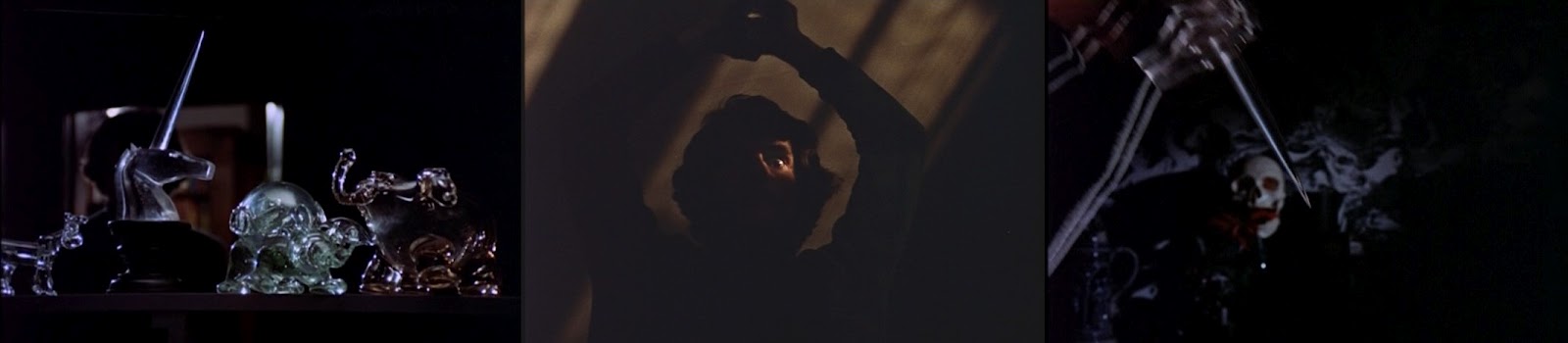
A few shots in the film remind me of Dario Argento, like a murder involving the use of a glass unicorn as a deadly weapon.  Clark also uses several moments in the film where a change in focus reveals important information, like a chilling scene that shows the corpse of one of the victims staring blindly out the attic window while her father walks through the snow below outside, only just beginning to feel a sense of panic over the fact that nobody can locate her. Another focus pull later in the film reveals a second victim hanging by a hook in the attic.

The film may have no real connection to "Halloween", but you can find a number of visual cues in "Halloween" that seem to have been lifted directly from this one, such as the use of the camera's first-person perspective to represent that of the killer's. John Carpenter also seems to have noticed this movie's habit of using ominous foreground cues and background cues, often with the killer lurking somewhere in the frame of the camera, unseen by the potential victims.
I love seeing Margot Kidder in this, as well as Andrea Martin. Kidder has a delicious role as a vulgar sorority sister Barb, who swears and drinks constantly, gives alcohol to children, and gamely gives the obscene phone caller a run for his money. Olivia Hussey is excellent, too, as our main heroine and final girl Jess. In contrast to many later slashers, especially the "Friday the 13th" series, "Black Christmas" portrays its female characters as intelligent and assertive; although the girls are having sexual relationships with their boyfriends, they're never presented even once as sex objects. Barb is dominating and blunt, even to her own mother on the telephone (she calls her mother a "gold plated whore" when she calls to change holiday plans with Barb so she can take a trip with her boyfriend to a ski lodge). Andrea Martin's character cancels plans with her own boyfriend to support her sister Barb, and even mousy Claire seems to be finding her voice being in the company of other assertive women; her father's shock at finding sexually suggestive items in Claire's room reveals that she is breaking away from a conservative background. Jess in particular displays a forward-thinking attitude when she is able to very carefully navigate a difficult conversation with her boyfriend in which she explains to him her reasons for wanting to abort their unplanned pregnancy. She makes a valiant attempt to explain to her lover that she doesn't want to have his baby or marry him.

As a final girl, she doesn't get to do a whole lot; "Black Christmas" only gives her one scene where she faces the killer, and after he chases her down into the basement of the house, that's pretty much it for their on-screen battle. That's a little disappointing when you view it in terms of the countless slasher movies that came afterwards, when the Laurie Strodes and Ginny Fields of the genre showed audiences how it's done.

Some viewers are frustrated by the film's ending, which offers no explanation about the killer whatsoever, even refusing to suggest his identity. Maybe that's why I love "Black Christmas" most of all, it knows that the identity of the psycho is more frightening because it's unknown and irrelevant. "Black Christmas" understands that violence and murder can be terrifyingly random, and these particular victims just happened to catch the attention of a maniac. They were simply in the wrong place at the wrong time.


Wednesday, December 14, 2011

How to Make a Monster: AIP's Gay Teenage Terror

American International Pictures is a name well known to geeks like me who love films from the 50s to the 70s, particularly low budget exploitation pictures.  Helmed by a sales manager and a lawyer, James H. Nicholson and Samuel Z. Arkoff, the company also employed Roger Corman, notorious film producer known for his cheap production values.  It was Arkoff who was savvy enough to devise a formula where he created films targeting males in their late teens, and the company made a lot of money off of horror and sci-fi films.  People are always reading subtexts into horror films, like when people talk about "Invasion of the Body Snatchers" and say "That was really about McCarthyism, man!"  I think "Invasion of the Body Snatchers" is really about alien pods that duplicate people, but the subtext of not being able to trust people is a powerful one, lending the movie its ominous weight. 

The AIP horror movies echoed some of the same sentiments, but there was a new plot device in the form of hypnosis.  Just like "radiation" had the potential to turn ordinary insects into lumbering giant predators, hypnosis had the power to turn ordinary people into murderous monsters, and it was being used by villains with dubious intentions.  "The She-Creature" featured a man who used hypnosis to cause a woman to "regress" to a point where she became a prehistoric monster--somehow this powerful hypnotic trance caused even her body to transform.  Hey, it was a reason to have a monster in a movie, right?


But if hypnosis was the tool used by the villains of the films, same-sex relationships were the terror that lent weight to the movies' supernatural monsters. AIP had also figured out its marketing scheme by now, and it paid off with the big 1957 hit "I Was A Teenage Werewolf". Along with this new teen formula, the scriptwriters had introduced a distinct homoerotic undercurrent, suggested by the doctor who preys on Michael Landon's teenage character and turns him into a werewolf without his knowledge.  "I Was a Teenage Frankenstein" was also released in 1957 and featured an older male doctor who created a body out of spare parts--a body that just happened to stitch together into the form of a hunky young man. Reminding us that his hands have been all over that body, the scientist famously tells the creature "Speak! You've got a civil tongue in your head, I ought to know, I sewed it there myself!"

On a double bill with the AIP "Frankenstein" film was "Blood of Dracula", where the gay suspicion was turned way up.  Although the film's creature is conceived as a vampire, it was still a werewolf-style transformation into a mute, hissing creature.  It takes place in an all-girl prep school, where maladjusted new arrival Nancy is immediately set upon by a predatory female science teacher who just happens to be dedicated to turning people into monsters via hypnosis.  Using an amulet she acquired in Transylvania (AHA!), she somehow turns our heroine into a vicious vampire with rat fangs for nighttime tantrums of murder and bloodsucking.  Her purpose?  To counter the development of the atom bomb by proving that the human mind is the greatest weapon.  Because, ya know, that makes a hell of a lot of sense, right?  There are a lot of unspoken motives for all of this, particularly the undeniable erotic tension between the science teacher and another one of her pupils, a young girl who blatantly helps lure Nancy into her predicament.


1958's "How to Make a Monster" followed up "I Was A Teenage Werewolf" and "I Was A Teenage Frankenstein", but introduced a self-referential format that was decades ahead of Kevin Williamson and Wes Craven.  The script of "How to Make a Monster" actually takes place in the studios of American International, where a sequel is in production that pairs the Teenage Werewolf with the Teenage Frankenstein. Spoiling the fun is a pair of new studio bosses who make the decision to abandon horror and concentrate on beach party movies and musicals.  They give a bunch of people the pink slip, including an aging monster-makeup artist who decides not to take it lying down.  Together with his simple minded (and obviously bottom-bunk) assistant, he uses the hunky teenage stars of the Werewolf/Frankenstein movie as his stooges in a series of revenge murders.  First he lures the boys into his makeup chair, where he applies special makeup that makes them open to hypnotic suggestion.  Then he instructs them to kill his enemies.  This makeup concoction is particularly mysterious, since it apparently causes a transformation all on its own, even without the hypnosis: the makeup man puts it on himself and transforms into a Mr. Hyde type monster that kills a nosy security guard.  The climax of the film finds him luring the boys back to his house, where he gives them alcohol and attempts to talk them into allowing him to..."put the makeup on" (wink wink)...one more time. The boys, however, start to remember the strange circumstances of their hypnotic trances, and the jig is up when the house catches fire.

I think it's pretty obvious these films were lightweight nonsense, but these "teenage" horror movies had dark underpinnings of strange, intimate same-sex relationships.  "How to Make a Monster" and "Blood of Dracula" in particular painted their evildoers as sexual predators, with a lesbian teacher and a dirty old makeup man as their real villains.  We know that this is the attitude that many people have about homosexuals themselves, even moreso in the 1950s when it was "the love that dare not speak its name". The actual "monsters" in these films were really victims, youths transformed into aberrations against their own wills or without their knowledge.  Once they allowed themselves to be placed in a suggestible situation with these older predators, their lives were forever changed without them even realizing it.  Usually they wound up dead at the conclusion, or in the case of "How to Make a Monster", carted off by police to pay for crimes they didn't even know they committed.

Tuesday, October 18, 2011

She Freak (1967) ... because calling it "Freaks" might have been too obvious.


Did you ever see the classic movie "Freaks" by Tod Browning?  Well, so did the makers of "She Freak".  If "Freaks" was a bottle of moviemaking fun that people bought in 1932, the makers of "She Freak" decided to soak the original bottle, remove the label, and slap a new label on it that said "She Freak".  Presto, something brand "new" to sell! 

The same wraparound gimmick used in "Freaks" is present here, with a bunch of people in a carnival freak show looking at some atrocious abomination they keep penned up for exhibit.  We don't see it, though, so we know that's the movie's big surprise.  If you've never seen "Freaks", and you were sometimes kept guessing by episodes of Scooby Doo, you will probably not realize who the freak exhibit will be.  The plot then flashes back to introduce us to a cold-hearted B named Jade Cochran.  Whether intentional or not, the film has a nifty little twist in the beginning when Jade is seen waiting tables in a greasy spoon.  Claire Brennan was a beautiful woman, and she makes Jade seem really cute at first.  Then she turns mean.  Real mean.  A redneck tries to pick her up and she turns him down, and then the lecherous diner owner puts the moves on her.  Jade has a complicated view of the world, though.  She smiles, and then she tells you you're pond scum and she wouldn't piss on you if you were on fire.  No, Jade reveals her gold-digging ways early on, and when a man stops by the diner bringing news of a carnival on its way to town, Jade wastes no time begging him for a job.  He refers her to the carnival boss, much to the chagrin of Jade's Mel Sharples wannabe diner boss.  His parting words to her are "You're goin down...all the way down...you're goin to Hell!"


From here on out, it's the plot of "Freaks".  Jade makes an impression on people at the carnival by smiling a lot, and she even makes a girlfriend out of a girlie-show dancer named Pat, who invites her to be roommates.  Jade must not be familiar with carnies though, because she wanders by the freak show and runs horrified back to Pat, complaining about how horrible they are.  Pat gently reminds Jade that these are her coworkers, but in a pivotal plot point, Jade insists she hates freaks. Pretty soon Jade's putting the moves on the carnival boss, Steve St. John, and all it takes is for one long, silent montage of Jade & Steve riding the ferris wheel (metaphorical?) and they're married!  What Jade reallys like, though, is the brutish Blackie Fleming, who roughs her up a little behind Steve's back.  Jade goes on another one of her anti-freak tirades, and Steve doesn't seem to be bothered that she's acting like a total sociopath, especially considering he explains to her that he gives the outcasts a chance to make their own living where they might not have that opportunity elsewhere.  Here's the funny thing, though: aside from a little person they call Shorty, none of the sideshow performers are unusual.  They're ordinary looking people doing unusual things, like swallowing swords and dancing with snakes.  A couple of them have frightmasks glued on their faces.  Big deal, they're not even interesting enough to hold someone's attention in a carnival freak show, let alone be considered "different". 


Shorty catches onto Jade's affair with Blackie and tries to warn Steve about it, and Steve slaps him for his trouble.  It isn't long before Steve finds out the truth when he catches Jade with Blackie, and Blackie stabs him to death after a fight.  Jade stands by and smiles coldly while Steve dies, and she sits back and inherits the carnival while Blackie gets carted off to jail.  Amusingly, she thinks she's going to run the carnival with an iron fist; she sends Shorty packing, and tells her former friend Pat to get back to the hoochie tent and shake her stuff where she belongs.  Jade's position as Queen of All Bitchdom is short-lived, though, when Shorty returns one scene later and corners Jade outside a couple of trailers with the entire group of "freaks".  Just like that movie called "Freaks" that you might have heard about, they cut Jade up real good and turn her into a sideshow of her own: the narrative returns to the present and shows Jade huddling in a pen with snakes, wearing some weird makeup.  So the people we're supposed to pretend are freaks ganged up on her and turned her into...a person we're supposed to pretend is a freak!  How's THAT for your M. Night Shyamalan moment?


This pseudo-remake (not to be confused with Pseudo-Echo) is of interest to me only because of its retro-chic appeal. And believe me, dear reader, the appeal is humble. "She Freak" was fun for me because I liked Claire Brennen's deliciously evil performance, too. She was a lot better than she needed to be for a movie like this, that's for sure. I loved seeing the old traveling carnival footage, and lucky for me it comprised about half an hour of this film's runtime.  "She Freak" has the vacant, meandering atmosphere of a Doris Wishman film. Long sequences are shot silent and presented as a montage, with imitation Lex Baxter lounge music over top of it. Lots of minor-key vibes tinkling over scenes of ferris wheels spinning. It's dead space, but it has a hypnotic effect as well. Sometimes it's interesting to see just how empty a cheap movie like "She Freak" can be.


Wednesday, October 12, 2011

Drive-In Super Monsterama 2011!

Tonight, we hearken back in time to a month ago. Better late than never, right?

I love, love, LOVE the annual Drive-In Super Monsterama.  This year's lineup was great; I only got to go Saturday night, and there's no way I was gonna miss that.  You think I'd miss BOTH Dr. Phibes films??  On the giant outdoor screen?? Watching them in the night air, while sitting on a lawn chair eating a funnel cake?  You've got to be freakin' KIDDING me!

First up was "The Abominable Dr. Phibes" and "Dr. Phibes Rises Again", back to back.  After you've grown used to a film on the small home screen, seeing it projected onto a giant screen can change the entire way you look at it.  The minute the film started and I heard that pipe organ blasting out of everybody's car stereo, I got the chills.  The lengthy opening sequence that passes entirely without dialogue was extremely surreal, almost like we were watching a silent movie. 

We also hung out for "Count Yorga, Vampire".  I'm pretty sure this is a repeat for the festival, although I know they showed the sequel, "Return of Count Yorga", one year in the past.  "CY,V" was a favorite of mine when I was a kid and vampires were the shiznit for me.  Nowadays, it doesn't grab me the way it once did (especially now that I'm too old to actually wonder whether vampires just might be real).  I do love that moment when the young couple breaks down in their van while driving down Count Yorga's long, winding driveway. They decide to go to sleep in the van, which is a far out 70s screwmobile with a bed in back.  Erica awakens in the middle of the night and opens the curtains to see the Count peering in at her...EEEEEE!  Well, what did she expect, breaking down in the driveway of a vampire?

The fourth and final feature was "I, Monster".  I, Was Tired.  So we left instead of watching Christopher Lee and Peter Cushing go through the paces of Jekyll and Hyde.  I did miss out on seeing some drive-in size Cushing, but at least I got to see him in his brief cameo in "Dr. Phibes Rises Again".  See you next year, Monsterama!